
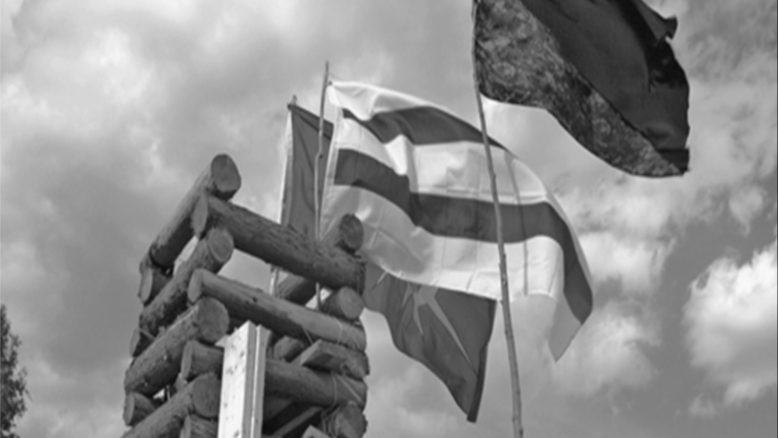
Anonymous submission to North Shore. This submission came with a link to a zine file, but the link was broken. If the author sees this, please try sending us the link again, whether through the submission form or by email.
*A text edited for the workshop “Cultures of Anarchist Anti-Colonialism” at the 2026 Hamilton Anarchist Bookfair.
**Note: This zine is a heftily edited version of chapters, ideas, and discussions that appear in the 2026 PhD dissertation. I have aimed to condense this work, and dispense with some of the excess academic referencing, language and theory. This is not to suggest that these elements cannot be useful to anarchists, but in the spirit of generating wider forms of discussion I present this initial edited version.
The interviews referenced here come from my conversations with 17 anarchists in Southern Ontario, that span a range of cities, communities, and scenes, and encompass a range of complex social identities. In particular, I highlight the words and perspectives of Indigenous participants. Pseudonyms were used to help to maintain some aspect of anonymity.
I hope these ideas further some of the ongoing and important conversations on anarchism and anti-colonial politics both here in Southern Ontario, but also further afield as well. My heartfelt and ongoing thanks to all who participated and supported this project over many years, and all the anarchist crews in Southern Ontario.
Of course for those with more academic and theory oriented desires I invite you to check out the full dissertation work as well:
Adam Gary Lewis. 2026. Cultures of Resistance, Cultures of Potential: Anarchist Value-Practices, Settler Colonialism, and Indigenous Resurgence. PhD Dissertation. York University.
Cultures of Anarchist Anti-Colonialism:
Considering Anarchist Prefigurative Possibilities for the Future
Someday, somewhere, today’s empires are tomorrow’s ashes.
—Propagandhi
Commitments to resist settler colonialism and articulate affinities with Indigenous struggles carry potentials for greater forms of anti-colonial politics within anarchism. Such commitments are important points of resistance and action within anarchism, but they are often limited, and require greater expansion in both theory and practice in order to actually generate disruptive forms of anarchist anti-colonialism.
Anarchists have long named settler colonialism as a key form of oppression and domination that needs to be opposed, alongside more standard anarchist oppositions like the state and capitalism. This is most readily visible in intro to anarchism books, zines, and discussions. Opposition to colonialism is nestled alongside the wide range of opposition to all forms of oppression and domination that characterizes contemporary anarchist politics. In many of these accounts, and especially those that are more theoretical in nature, there is little discussion as to what this sort of anti-colonial opposition might look like. There may be vague nods to support for Indigenous resurgence, or wider histories of complicity with international forms of anti-imperialist struggle, but rarely is there more detailed discussion of how committed form of anti-colonial politics might be enacted in here and now –in specific places at specific times– and with direct reference to the histories and flows of struggle that might disrupt anarchism for the better.
This results in a tendency to leave colonialism among a wider laundry list of things to be opposed, and lacking in greater qualification and consideration of what this means as practical forms of politics. How, then, are anarchists actually seeking to practically, materially, and intentionally oppose settler colonialism, and support Indigenous resistance and resurgence? This zine attempts to shed light on some of the everyday ways that anarchists in Southern Ontario are engaging this work, and how they are thinking about the relationship between anarchism and anti-colonial politics.
I consider how spirituality, history, relationships to land and place, and prefigurative imaginations for the future interact with anarchist anti-colonialism. I begin with spirituality as a tension that is perhaps even less discussed amongst anarchists, but which intersects directly with Indigenous resurgence politics, given the centrality of Indigenous cosmologies, grounded normativities, and relationships to land. The limited anarchist approach to spirituality is a stumbling block for anarchist affinities with Indigenous struggles, as well as settler anarchist attempts to reorient our own connections to land and the sorts of grounded relationships to land that our ancestors once had. Considering spirituality allows anarchists to begin to think carefully about their own traditions, ancestors, and grounded connections. I argue that anarchist celebrations and traditions around May Day are potent examples to more carefully understand anarchist connections to the past and enact greater anti-colonial politics in the future.
This further points to the ways that anarchists might reconceive their relationships to land and Indigenous resurgence movements, and inform their relationships to the future. Anarchists can draw strength from our own traditions and practices, as ‘subaltern knowledges,’ to foster accountability, to land, place, and Indigenous resurgence movements, while refusing appropriation.
I argue for a greater expansion and articulation of committed anarchist anti-colonial politics, and for furthering our accountabilities and complicities with Indigenous resurgence to enact a greater commitment to radical imaginations and futures. Engaging with the tensions discussed above, putting them to work, and fostering wider collective consideration of them can create moments of contention and disruption to animate anarchist anti-colonial politics going forward. Anarchism holds a great many potentials, it is incumbent on us, as anarchists everywhere, to continue to realize them.
Spirituality, Ancestry, and Tradition
Spirituality is a tension that is intimately connected to relationships and the construction of anti-colonial possibilities. As Indigenous resurgence theorists like Glen Coulthard and Leanne Simpson (2016) argue, Indigenous grounded normativities reflect the ‘ethical frameworks’ and forms of relating provided by ‘Indigenous place-based practices and associated forms of knowledge’ (p. 254), firmly rooted in Indigenous worldviews. Any construction of affinities, relationships, and complicities with Indigenous resurgence need to consider and be accountable to these forms of relation. Spirituality asks how anarchists can understand our orientations to Indigenous struggle and the lands we inhabit, but also our relationship to our own ancestors, traditions, and histories.
Raised in early interviews, spirituality finds tension between the recurrent atheism of anarchists and the culturally grounded spiritualties of Indigenous perspectives. These differing approaches to spirituality are more likely to be a place of lacking affinity, rather than an easy space to build upon it. The frequently dogmatic or dismissive position of anarchists and anarchism in general results in disagreements that limit the abilities for more pronounced relationships and alliances (see, for example, Sloan Morgan, 2016; Fortier, 2015). Those who discussed spirituality in my interviews, however, tended to adopt a critical view to such anarchist dismissals, and were beginning to consider the implications of such an approach, given the context of settler colonialism and Indigenous resurgence. This is a tension that needs greater unpacking, interrogation, and reformulation within anarchist culture if we are to expand anti-colonial anarchist politics further.
Anarchists tend to have a very strong atheist critique of religion that runs from classical anarchism into the present. This is reflective of the hierarchy and authoritarianism within many of the dominant religions, namely hegemonic Christianity. Bakunin’s God and The State (1916/2009) is one of the foundational works in this regard. He assesses the rise of the state alongside religious forms of domination, where the church and state mutually reinforce power and domination. Emma Goldman’s (1917/1969) summary of anarchism, and opposition to all forms of domination, names religion as the first marker of domination: ‘Anarchism really stands for the liberation of the human mind from the dominion of religion…’ (p. 62). This strong anti-religious sentiment runs through much of classical anarchism but continues into the present as well. The slogan ‘No Gods, No Masters’ captures such an ongoing sentiment.
There have been, however, recent attempts to consider the affinities of anarchism with various religious perspectives, such as Christianity (Christoyannopoulos, 2010), Islam (Abdou, 2022), and Judaism (Hayyim, 2023), amongst others. These approaches consider connections with religious values, ethics, and practices, to develop a specific anarchism (Christian anarchism for example) or to illustrate fruitful points of contact between religious perspectives and anarchist politics without consolidating them into a singular position.
I am less interested in the dominant religious strands and how anarchist perspectives could find alliance, resonance, or incorporation into them (this is altogether another discussion). Rather, I want to consider how a generalized anarchist rejection of religion and spirituality forecloses opportunities for greater affinities within Indigenous struggles, how it may limit a greater understanding of the dynamics of settler colonization and dispossession, and how such rejections actually limit and marginalize the construction of specific forms of spirituality within anarchism.
Part of the difficulty is the collapsing of spirituality into dominant, authoritarian, and hierarchical forms of religion. While authoritarianism and domination frequently go together within the dominant strands of religion in the Western world, taking such a firm and inflexible view to other expressions of spirituality limits the construction of spiritualties and affinities outside the dominant forms (Lagalisse, 2011). In contrast to dominant Western religions, Indigenous grounded normativities and cosmologies are fundamental to Indigenous relationships to land and form deep reciprocal and accountable connections between the physical and metaphysical world. They fully inform resurgence politics and resultant oppositions to the state and capitalism, while also resisting domination by hegemonic forms of religion. Leanne Simpson (2011), for example, frames Nishnaabeg forms of storytelling as a central aspect of spirituality and resurgence, as prefigurative, as a ‘lens through which we can envision our way out of cognitive imperialism, where we can create models and mirrors where none existed, and where we can experience the spaces of freedom and justice’ (p. 33).
Enacting affinities between and across anarchism and other perspectives requires working through this tension around spirituality. Erica Lagalisse (2011) asks ‘how a secular worldview compromises anarchist activists’ ability to engage in horizontal solidarity across difference’ (p. 653). Looking at solidarity organizing amongst anarchists in Montreal, Lagalisse considers the gendered implications of anarchist anti-colonial solidarity with Indigenous struggles and how such approaches often dismiss Indigenous spiritualties that ground resistance movements, and ultimately limit the deeper possibilities for both solidarity and the imagination of alternatives beyond the state and capitalism. She notes the historical specificity of anarchist forms of secularism and anti-religious sentiment and the adoption of a critique not only of organized forms of religion, but also of the sacred and spirituality more generally (p. 664).
Lagalisse (2019) further points to the specifically gendered dimensions of anarchist dismissals of spirituality, noting
It is not simply sexist reading habits that marginalize Indigenous women scholars’ work but also the fact that their words, insofar as they draw links between politics and cosmology, are less easily recuperated within the European anarchist tradition, which has already decided that religion is bad, and whose model of oppressive power is the state. (p. 83)
Theresa Warburton (2021) highlights a comparable unwillingness by anarchists to engage with Indigenous women’s writing in ways that should be transformative. She engages ‘Native women’s literatures to demonstrate that anarchists can no longer depend on a politics that looks at this place and assumes that there are no politics here; that such politics must be created to envision a world without the state and without capitalism’ (p. 25). Warburton’s work calls for more intentional engagement of Indigenous perspectives, lifeways, and existences that persist outside and against capitalism and the state, and which already offer transformative visions of the future.
Anarchist perceptions of spirituality were raised in my interviews, both in general, and specifically in relation to anti-colonialism, solidarity, and Indigenous resurgence. Lila was very direct in their assessment of many anarchists’ approaches: ‘I think that anarchists are very spiritually impoverished.’ Lila framed their approach to relationships in general through the lens of humility that prompts a critique of anarchism in general, and anarchist approaches to spirituality:
I feel like there are many anarchists who their greatest love is politics. And then, like, that has no heart. That has no staying power. That does not sustain you through repression. That does not sustain you through any kind of crisis. It doesn’t sustain you through grief. It doesn’t sustain you through illness. It’s, like, all on the level of intellect and thought. And I think that we are so much stronger and more powerful and more resilient and more fucking ferocious when there’s a deeper connection. And I think that we do a pretty good job finding connection with each other. But I think that we would be, like, so much more deeply nourished, so much stronger, if we, you know, engage with spirit, and that can look like so many different things.
While politics will continue to be central to how anarchists, Lila argues that this has its limitations in terms of ‘deeper connection’ and relationships. Relationships and relationality are a core aspect of how anarchists can think through culture and their affinities with Indigenous struggles. The emphasis on politics, as implicitly secular and non-religious, comes at the expense of the greater forms of spirituality and relationality that Lagalisse (2011) identifies.
Regarding Indigenous spiritualties, participants generally acknowledged their importance and significance, but suggested that anarchists rarely go further than a surface level of acceptance, or even mere tolerance. Interviewees raised questions of why we should understand Indigenous spiritualties and normativities as different and what that might mean. How does that challenge our own practices/perceptions, ways of engaging relationships, and orientations to the future?
Brian suggested that anarchists haven’t quite figured out where Indigenous spirituality ‘fits,’ despite often acknowledging its importance:
So my friends practicing Indigenous spirituality and stuff like that, I’m, like, very pro it. I’m happy that helps them in this world. I think it’s a little weird to do it in our social gatherings and big things or whatever. I think there is space for it in events like the Anti-Colonial Thanksgiving Dinner or events where it’s like centering Indigenous voices, if people want to bring forward their spirituality and [say], like, “this is central shit.” … I think when some of the radicals who are traditionalists bring up, like, the Great Law and bring up specific worldviews and conceptions to describe why they engage in struggle and, like, what they want to get out of the world in the long term, I see that as, like, cool.
Anarchists recognize the importance and strength of spiritual grounding in resurgence and land defense struggles specifically, but perhaps haven’t quite figured out how it might fit within—or disrupt—anarchism more broadly and allow anarchists to consider their own spiritual groundings. Such a process isn’t entirely absent, however.
As Brian mentioned, the Anti-Colonial Thanksgiving Dinner in Guelph was a series of events organized with participation from anarchists, beginning in 2005, that created space ‘to unlearn colonized ways of seeing each other, ourselves, and the land, and to heal relationships between Native and non-Native people’ (Unsettling Guelph, 2019, para. 2). These events hosted a range of speakers from different Indigenous communities, like Six Nations and Tyendinaga, and connected resistance struggles, with the aim of forging new relations between communities, and expand the possibilities for wider anti-colonial and decolonial politics. These spaces of encounter might disrupt anarchist perceptions of spirituality, and its importance for Indigenous resurgence, while also providing new ways of rethinking anarchist forms of spirituality, and wider anti-colonial politics.
Violet pointed to land as a specific relationship that we are all accountable to, and how there is some recognition by anarchists as to the more spiritual dimensions of resistance within this ‘bigger context.’ Violet stressed that, being an Indigenous person, their worldview as Anishinaabekwe,
has to necessarily include settler colonial ideas because this is the society that I’m living in, right. So I’ve got the experience of like reclaiming my own worldviews and my own thought processes, but also being aware of and being immersed in settler colonial theories and practices.
This gave Violet direct insight into the spiritual dimensions of resistance, in ways that are not yet totally developed amongst anarchists in a broader sense. They suggested that in some ways anarchists are attracted to Indigenous resistance struggles, ‘seeking the sort of community that Indigenous peoples have or are seeking to recreate’ because they lack their own traditions, given their own (settler) histories of dispossession and loss of relationships to land and spirit.
Lila pointed to the ways that some anarchists, like other settlers, have looked to Indigenous communities, but often in ways that are for their own benefit and spiritual enlightenment, rather than as a process of forming new forms of relationships and complicity:
And so I see more and more often in people who are engaging with colonization, who are wanting to learn more about Indigenous culture and spirituality, it’s just like, “I want that now.” And because it’s like there is this legacy there, there are these roots that you can trace back. And there’s so much power in that. And there’s, like, so much potential for healing there. And I feel like as a settler of Irish, English, and German Mennonite descent there is this kind of, like, cultural, spiritual impoverishment almost. Where it’s like, “If I don’t identify with the Bible, if I don’t identify as a Christian, well, then what’s mine?”
Many settlers have lost their own cultural and spiritual connections, in part due to other processes of colonization and dispossession, or moved away from them because of political incompatibilities, and see certain affinities with Indigenous spirituality that they are missing within their own communities and cultures. As Lila observed, ‘one of the legacies of settler colonialism is that settlers are almost rootless, that I don’t have my own meaningful traditions, I don’t have a spiritual inheritance.’ Colonial forms of dispossession happened to settlers as well, and continue to impact their forms of relating to land and place.
Violet and Lydia, coming from perspectives that incorporated their Métis and Anishinaabe Indigenous heritage and elements of anarchism, observed the frequently dismissive anarchist attitude towards spirituality, and argued for the importance of engaging the spiritual from cultural and land-based perspectives. Violet reflected on the ways that Anishinaabe spirituality fundamentally grounds their work:
I’ve had folks conflate spirituality with religion and that’s been my biggest experience. But then within those close relationships that I have with people, I’m able to kind of have conversations about “why do you protect the land and water, if you don’t believe that the land and water has a bigger purpose in our lives than being a resource?” And then one person in particular was like, “Yeah, you’re right.” And I was like, “You know why I don’t get burnt out? … Because I love what I do, I love protecting the water and I love protecting the land. Because I know that it also protects me. So I have a relationship with the land and the water.”
Relationships are central to Violet’s approach to resistance and land defense and provides a basis to challenge others’ lack of spiritual grounding:
In terms of, like, finding a relationship, I don’t think that spirituality is necessarily about like, I mean, religion in the sense of how the church is oppressive and violent. I think the same impacts have been had on Indigenous peoples in terms of, like, the church and the state working together, like residential schools for example. So I think that anarchism in that sense needs to, as well, take a look at how Indigenous peoples are certainly facing the same sorts of things, the same sorts of violences of, like, the church in that state, for example, and then to take more time to think about how spirituality and how our connection to the land and how our language and how our ceremonies were targeted by the church and the state. And I think that’s essential because if we’re looking at why colonialism happened and the reason, there’s always a reason.
Violet concludes that there is a potential for engaging spirituality differently within anarchism but it requires specific work:
I think the majority of anarchists that I’ve worked with are, like, incredibly intelligent and that if they apply this analysis to spirituality versus religion in the context of Indigenous oppression and genocide that there’s a big key right there about understanding what we have in common and that not being generalizing about religion and spirituality and things like that, that there could be maybe more room for talking about utopia, how we’re making these strides, where it’s creating this space in society.
Engaging spirituality actually opens up greater possibilities for relationships, affinities, and radical futures. Lila expressed a similar sentiment, arguing that ‘political theory isn’t roots’:
I think that we grow roots, and many of us are rootless because many of us are settlers and don’t know very much about our history or the history we do know can be horrifying, like knowing what our ancestors have done can be just really disheartening. And I feel like we need roots for nourishment and strength and resilience. And I think that we get that through, you know, developing rituals and traditions that make sense to us. And like it’s about creating meaning, ultimately, in our lives and in our relationships. I do feel sad for us.
Both Violet and Lila considered how anarchist spiritual practices might help to nourish and sustain their day-to-day articulations of politics. Spiritual forms of practice might help in the maintenance of anarchist culture, and in expanding anti-colonial politics as well.
Lydia recalled the ways that anarchists accept the importance of land acknowledgements and Indigenous spiritual openings, as part of land defense work, but also continue to evidence a dismissive or paternalistic attitude in wider solidarity work. Lip-service or tolerance is often given to Indigenous forms of spirituality, but isn’t taken seriously as a central grounding for resistance work. Spirituality is tolerated to access the direct action resurgence politics that anarchists are more readily willing to align with. This tacit acceptance is less about intentionally making space and upholding the importance of cultural and spiritual groundings, and more seen as a necessary compromise for engaging in affinity and solidarity.
Lydia framed their Métis grounding in Indigenous spirituality in the following way, which I think can help anarchists to understand how this pushes against dominant and normative understandings of religion and captures key elements of relationality, accountability and critique:
The best way I’ve heard it described to me [by a friend] was like, “Well, I would just say that we’re like Pantheists or whatever more than anything.” You know, monotheism—one god, Polytheism—many, atheism—no god, pantheist is like everything is God. And so in that framework I actually think it is like a non-hierarchical thing. And so it’s like, I am just as— not only, like, powerful, important, but also accountable and capable to actually do the good things in the world rather than asking God or something like that. And as like anybody else, really any other thing, everything has rights and everything has responsibilities. And that’s kind of the way it’s framed. And so I don’t really see it as being a very hierarchical thing. And I think that, like with anything, those things can be exploited. And I think that like spiritual leaders and communities, whatever, can develop unhealthy patterns of relation. I just don’t actually think it has to be that way. And I actually think that when it does end up that way it feels unnatural and not actually in line the teachings.
Lydia noted the dynamic nature of spirituality, as an ongoing set of relationships, but also in terms of how specific individuals, or leaders, engage with it in different ways.
Anarchists could consider what relational, accountable, and radical forms of spirituality could look like from their own perspectives, while refusing appropriation of Indigenous lifeways and .attempts at ‘settler Indigenization’ (Tuck & Yang, 2012) that replay core dynamics of settler colonialism There is a danger of becoming what Adam Barker (2021) calls ‘settler bricoleurs,’ who assert ‘the power to select, preserve, and recontextualize elements of Indigenous cultures and histories in settler colonial space- including bodies, stories, artwork, names, and terms’ and which ‘extends to the creation of implicit meaning’ (p. 106). There is a necessary vigilance required to ward off implicit re-colonizing desires to translate and remake everything on our own terms. Therefore, it is even more important for anarchists to consider what spirituality might mean in relation to our own histories, politics, and futures, even as we also support Indigenous forms.
For Willow, Lila, KR, and OS, (in addition to Indigenous participants Violet and Lydia) spirituality formed a key component of their anarchist identities and approaches. But for most participants, while they occasionally referenced the importance of spirituality in terms of working with Indigenous struggles and requiring more careful and intentional anarchist thinking, it didn’t shape their individual anarchist politics. While this doesn’t definitively indicate a lack of general spiritual connection in anarchism, it’s clear that spirituality doesn’t form a core component of these anarchists’ political and cultural frameworks.
Anarchists do, however, often speak in very general terms of a ‘spirit’ of anarchism that runs from classical anarchist formations through to the present, which evokes concepts of commitment, faith, ritual, and ongoing practice, albeit from a different standpoint. Emma Goldman (1917/1969) explained this ‘anarchist spirit’ as follows:
Anarchism, the great leaven of thought, is today permeating every phase of human endeavor. Science, art, literature, the drama, the effort for economic betterment, in fact every individual and social opposition to the existing disorder of things, is illumined by the spiritual light of Anarchism. It is the philosophy of the sovereignty of the individual. It is the theory of social harmony. It is the great, surging, living truth that is reconstructing the world, and that will usher in the Dawn. (p. 67)
Goldman includes recurrent references to ‘international spirit,’ ‘mass spirit,’ ‘spirit of revolt,’ etc. throughout her explanation of anarchism. This is carried forth in similar ways into contemporary writings on anarchism. Cindy Milstein (2010) evokes the complex, messy, and dynamic nature of anarchism and spirit:
At its core, anarchism is indeed a spirit—one that cries out against all that’s wrong with present-day society, and boldly proclaims all that could be right under alternate forms of social organization. It is also precisely the quality of an airy free-spiritedness that gives anarchism its attraction. Anarchism playfully travels across the mists of time and space to borrow from the best of human innovations, to give body to the most lofty of ideals. It can be hauntingly beautiful. But it involves a difficulty as well: pinning down this ghostly figure, this “inhabitant of an unseen world,” with any definition or substance, much less getting other people to believe in the utopian apparition called anarchism. (p. 11)
These are the impulses, the ways of being, the hopes for the world, and the radical imaginations that animate anarchist activities and evoke a spiritual grounding beyond the material. Spirit, in this sense, is ‘a way of organizing and relating that opposes hierarchy and embraces direct democracy’ (Sitrin, 2015, p. 84) within anarchism, but also within other horizontal and anti-authoritarian movements the world over, including Indigenous struggles.
Willow noted how their anarchism and spirit ‘have always been really connected,’ linked with nature and natural processes, and the ‘magical’ elements of their spirituality as a self-identified witch:
I think that my spirit is alive, knowing that science, magic, like, life force that I feel. Like I wouldn’t say that it’s some God. It’s like, if I have any master, it’s the seeds … I believe in that feeling. I believe in the magic that is life, that is seeds in the soil. So I want to caretake the soil. I want to, like, pay attention to the moon. I want to pay attention to the rain. I want to honour the natural elements that sustain life. And I think that that connects me to this undying and unwavering belief in mutual aid, voluntary association, justice, like all of those things because they’re under attack. The very essence of my life and my spirit is under attack.
This becomes the very rationale for resistance against systems of domination and destruction.
While some anarchists are likely to rely on theory and politics to ground their day-to-day cultures of resistance, others like Willow point to further forms of relating and connection that inspire action and resistance. In both cases, relationships and connection are at the heart of anarchist cultures, values, and practices. How they are mobilized, interpreted, and imagined, however, is going to be different for different people. This makes the potential for a dynamic and enriching discussion of spirituality and its connection to politics even more interesting.
Spirituality, while likely to still be polarizing and contentious for some anarchists, can further anti-colonial politics and enhance radical forms of relationships and affinities. Re-engaging with spiritualties that consider relationships to land and place might help anarchists recognize ‘that while it is important to learn from ancestral spiritual practices, we have a responsibility to re-imagine what a contemporary spirituality looks like given the long-standing traumas and histories that have transformed our relationships with each other, the land, and Indigenous peoples’ (Fortier, 2015, p. 325). This is a collective but also deeply personal process. Bringing greater intention into these practices can help to extend them further and contextualize them into a specifically anti-colonial relational framework.
As I reflected in my conversation with Brian, anarchists can consider
what are some of those stories that we have, that like, we can use to frame our perceptions of the world and things like that. And maybe a bunch of it is just, like, kind of theory type stuff. But like maybe there are stories from, like, some of our own cultural reference points and like there’s histories of struggle … against the enclosures in Europe that, like, lots of anarchists had some connection to, or things like that.
There are histories and struggles that can inform renewed anarchist approaches to spirituality. As I discuss below, May Day is one possible reference point that is already widely considered by anarchists.
Tawinikay (2021) argues that there is an importance in (re)connecting to ancestors for anarchists, but only if it is done outside of relationships of appropriation, power, status seeking, guilt, and shame:
I believe that we push harder when we fight for our own freedom and existence. I believe we try harder to build community and relationship when we feel rooted in place. I believe that being motivated by a personal connection to and love for the land makes us better anarchists, and gives us the best possibility to create a new world less shitty than the old. I want all of my friends in struggle to find those things, on their own terms, from their own tradition (historic or invented). Let us not forget that all tradition, ceremony, and ritual is created by us to make meaning of the world around us and of our relationships to each other! (p. 29)
Rituals, celebrations and traditions are central to Indigenous forms of relating, but can also inform anarchist forms of connection, relationship, and affinity, and their more intentional construction. To be clear, these will be wholly different sets of relations and traditions that come from anarchist standpoints directly, and refuse the creeping forms of appropriation of Indigenous practices already mentioned. These practices might also further motivate wider non-Indigenous people and settlers towards greater forms of anti-colonial action.
To disrupt the more atheistic, dismissive, if not appropriative, anarchist approaches to spirituality, we have to take seriously the challenges from Indigenous resurgence approaches to carefully and intentionally consider spiritual practices that have long been underway—and consider our own orientations to culture, tradition, land, and the sacred. This opens up space to consider further other ways of being, the ‘other worlds already here’ (Warburton (2021), and other possibilities to (re)imagine relationships to land and the future.
Embracing Anarchist History and Tradition
Anarchists can consider reference points within histories and traditions to mobilize their own spiritual connections towards greater forms of anti-colonial politic and connections to the places that they live. I consider May Day as a potent example given its prominence in anarchist culture, and the intersections between struggles that it draws forth. May Day helps to imagine how we can connect anarchist histories and traditions to the present, and then actually start to think about our own spiritual and political groundings that might move us towards deeper forms of transformative anti-colonial politics.
May Day looms large in anarchist history, tradition, celebration, and culture. The original struggle for the eight-hour workday, the Haymarket Affair of 1886 and the hanging of the Haymarket Martyrs, continues to be remembered and celebrated by anarchists. Many of my interviewees had been involved in May Day organizing and referenced it as a key cultural moment in anarchist politics. As I discuss below, and as Warburton (2021) critiques, May Day also has certain limits in the ways it is often considered within settler colonial contexts. I argue that re-engaging May Day can serve as a disruption of this tendency to overlook settler colonial contexts and histories of Indigenous struggle, and instead can link together anarchist spiritualties, histories, cultures of resistance, subaltern knowledges, and prefigurative possibilities of the future towards more committed forms of anti-colonial politics. May Day is a touchstone for linkages between current forms of anarchist culture, and future anti-colonial possibilities.
May Day has wide opportunities for considering new forms of relating and being in the world. Lila directly connected May Day to greater ways that anarchist spirituality might be considered:
I feel like May Day is something that I want to celebrate, as an anarchist and as a witch, as someone who makes a conscious effort to be a little bit more engaged with the rhythms of the earth and the seasons and stuff like that. And it felt kind of cool to be like, this is important to me as an anarchist and as a witch. And that those are two really important parts of my identity and they feel like they really beautifully support and nourish each other. I feel like being an anarchist makes though like somehow just more sense to me. It feels more, somehow, balanced, more grounded. … I’ve really slowly over the years been like, “How do I also weave my spirituality into this? How do I nourish it and grow a spirituality that isn’t based on power and hierarchy and some shitty fucking dude in the clouds being a prick?”
For Lila, organizing May Day celebrations was a way to take up greater engagements with anarchist histories, traditions, and spiritualties:
I think that creating rituals and traditions is important. So, like, May Day is something where I think that that means something. For me the solstices and the equinoxes … I feel like I have my own practices, I have my own things that … have just slowly evolved, some that I’ve learned from my mom, some that I’ve been part of creating with people in my life, other friends and witches … you know, New Year’s Eve [anti-prison] demos, and I really think it is important to have things through the year that can really build on themselves and build meaning.
Willow pointed to May Day as a specific anarchist moment that connects spirit, place, and politics:
I think that a big thing that we’re missing is like honoring what it actually is to be alive. And so that’s where things like May Day become very exciting for me because I think part of my anarchist politics, is that … capitalism is interrupting our very ability to be alive in play and just live … let alone, like, evolve our ideas into greater capacities. It’s interrupting the very essence of life and that will forever be terrifying. And … May Day is like an opportunity to meld those worlds, make space for play and honor that play can be resistance. And, like, play comes in because you’re, like, you are at the whim of the seasons.
This sort of ‘weaving’ and ‘grounding’ suggests an ongoing and dynamic process of connecting anarchist values and practices to other forms of being in the world, and the need for conscious efforts to bring these connections into sharper view. May Day speaks to the larger potentials of celebration and ritual within anarchism, as a means to forge our own relationships with history, culture, and spirituality that can come from more general forms of anarchist gathering highlighted by Wood (2019) that maintain and reproduce anarchist culture. As the contributors to the zine ‘Anarchy in a Small Pond’ (613 Anarchy, 2018) contend, rituals around things like May Day have a certain importance and power in smaller cities and towns where there aren’t likely to be large, rowdy confrontational demonstrations, but where these smaller events continue to maintain and further create elements of anarchist culture.
Peter Linebaugh’s (2016) ‘Incomplete, True, Authentic, and Wonderful History of May Day’ speaks to some of the potentials of returning to May Day as not just a history of struggles (both red and green, he argues, proletarian and ecological, of both land and freedom) but as a set of interconnections that raise considerations for the present. Linebaugh’s ‘history from below’ connects Haymarket and workers struggles to broader processes of dispossession and colonization, theft of lands and bodies, and the creation of capitalism and states. He argues that ‘May Day is about affirmation, the love of life, and the start of spring, so it has to be about the beginning of the end of the capitalist system of exploitation, oppression, war, and overall misery, toil, and moil. Besides full affirmation May Day requires denunciation; the denunciation of capitalism, of patriarchy, of homophobia, of white supremacy, of war’ (pp. 8–9).
KW May Day (2018) presents a similar framing, linking analysis and resistance of domination and dispossession with broader hopes for the future:
We see May Day as a space to continue building stronger and more transformative movements. We come from a range of perspectives, experiences and politics and seek to find strength in our diversity. In the face of continued forms of settler-colonial, white supremacist, state, capitalist, and heteropatriarchal violence it is imperative to integrate our modes of resistance. As systems of domination are connected, so too are our movements. We hope that this event will plant seeds for further engagement, discussion and collaboration between our communities.
Further, the 2018 Collective Statement highlights the explicit connections between May Day and struggles against settler colonialism:
Colonization, and the ongoing resistance to it, must be at the forefront of understanding and working within our local context, our desire to strengthen our relations with Indigenous peoples and communities, and how we live out our values and desires for better futures. This asks settlers to consider their place as occupiers and residents on lands that have been stolen but are increasingly being taken back. These are also among the struggles putting forth the most damning critiques of capitalism and reconciliation with the colonial state, and putting alternative futures into practice.
May Day is a lens that can aid in the interpretation and understanding of history, and anarchist lineages that can traced, nurtured, and expanded. As a friend of mine once suggested, we might consider our anarchist ancestors, anarchist kin, who perished at both Haymarket and in so many struggles since, as a way to connect directly to the past and help us inform the present. I want to concede that this is a bit of poetic interpretation, not a literal identification of blood relative kin, but perhaps, following Goldman above, an approach to connecting to anarchist spirit.
May Day presents an opportunity to reimagine how we conceive of ancestry, kinship, and relationships, and how such re-imaginaries carry radical potential. May Day, and a broader affinity with anarchist relatives, might be one way to find some of our own (settler) anarchist traditions, in ways that refuse appropriation of Indigenous ones, and reaffirm our own connections to politics and spirit. Seeking our own ancestors in struggle might actually expand our potentials for ongoing forms of political and anti-colonial action as this reorients our attention to history and spiritual forms of relating that can be contextualized to the lands that we currently inhabit (alongside broader processes of constructing affinities, complicities, and accountabilities).
It is crucial, however, that these points of reference and inspiration don’t also exclude or neglect criticism of our practices that can move us towards greater forms of anti-colonial politics. As Warburton (2021) argues, we need to contextualize such histories, but also uncover, and then resist, the structures of settlement that persist within them. For example, she discusses the ways that the Haymarket Riot (as the impetus for May Day), and other touchstone events in anarchist history (like Seattle in 1999), are narrated as significant moments of resistance, but exclude Indigenous resistance movements at the time, and since. Warburton highlights how the Haymarket Martyrs are often constructed as ‘indigenous,’ homegrown anarchist examples in ways that obfuscate the settler colonial context of Indigenous dispossession and the ways that immigrant, second-generation and ‘native-born’ anarchists are still embedded within settlement relations. Anarchist narratives of transnationalism and migration leave out the ongoing nature of settler colonial dispossession and its associated structures, leaving them intact and maintained within anarchism itself, despite anti-colonial declarations (p. 167). This has profound implications for the ways that anarchists understand place and land (Warburton, 2020).
Overall, there is room for a greater dynamic conversation within anarchism on how we collectively and culturally understand spirituality and connections to the past, and how these elements can inform anarchist values and practices in the present. This discussion and further development must be firmly placed within the settler colonial context in which we find ourselves. This means considering how holding up anarchist histories can be accountable to, and placed in context with, histories of Indigenous resistance and resurgence. Anarchist histories, spiritualties, and relations don’t occur in isolation, and, as Warburton (2020, 2021) illustrates, need to consider intersections with structures of settlement. As my interviewees reflected, spiritualties, traditions, histories, and the broader relationships to other struggles are continually under construction, but need greater discussion and development. The affinities that anarchists have already expressed with Indigenous struggles ought to prompt greater interrogation of our own constructions of culture within anarchism within the explicit context of settler colonialism and ongoing Indigenous resurgence.
Spirituality is one place where there can continue to be greater discussion and imagination on the part of anarchists. We can build out our own traditions and touchstones to further deepen anti-colonial values and practices on our town terms, related to the contexts and histories we inhabit, and towards the prefigurative radical futures that are so desperately needed. These are places to find greater forms of relating and connection, from which further action can spring. They place us into webs of relations that can challenge and disrupt forms of baseline opposition, and (re)orient towards greater anti-colonial politics.
Connection, Place, and Land
Anarchists need to find ways to discuss and expand anti-colonial politics in committed and intentional ways, place themselves in a greater context of relationality to Indigenous struggles and resurgence and their own cultural contexts, and consider how settler colonialism as a context continues to shape their expressions of resistance and hopes for the future. Cultural reference points like May Day can be helpful to (re)construct anarchist traditions and consider the wider adoption of anti-colonial politics.
Lydia expressed this perspective directly, in a way that touches on the variety of themes I have discussed so far:
Yeah, that’s kind of where I’m headed these days … trying to figure out how could settler anarchists find a bigger base of support for themselves on which to talk about those things. So it’s like you’re not just standing there as an ally and being like, “Indigenous people want this, Indigenous people want that.” You’re actually standing up there and being like, you know, “This is who I am, this is my place here. This is what I care about. This is a relationship I’m seeking to build. And because I want to build this relationship, I’m taking this action because I feel like this is like the actions that will lead me into better relations with those people.” And so it’s like taking a lot more responsibility for yourself and not just this like self-flagellating thing of like, “I’m so bad, my ancestors are so bad,” but being like “I’m here, I have things I can do now. I’m obviously not going back to Europe. So like, what am I doing right now? And like, what are like concrete actions I can do?” Yeah, but coming from a place of, like, not guilt but of, I don’t know, hope, futurity, something like that.
Taking responsibility, moving beyond allyship, and situating oneself are key places for greater anti-colonial work within anarchism. As Lydia continued, this is an ongoing process that requires consistency:
If you want to build relationships with Indigenous people, you actually have to pick one spot and stay in that spot and commit to it. And I think that that’s like, it’s an important thing and it’s an important thing for building trust. Like, you have to be in contact with those people. Not constant, like, sure you could be friends that’d be great. Like over the years, you have to consistently show up. You can’t really show up one time and disappear for three years and show up again.
Lydia and I discussed the sometimes transitory nature of anarchist cultures, where certain cities like Montreal develop a reputation for anarchist activity and culture that draws in anarchists from other locales. While this allows for connection, cross pollination, and sharing between localized anarchist cultures, it can limit ongoing, committed, and accountable relations within a specific context..
Participants were quick to point out that some anarchists have begun this work already, and this can serve as a crucial reference point for expanding anarchist connections and complicities going forward. Lydia specifically pointed to the anarchist project ‘Knowing the Land is Resistance’ (KLR) as a useful example. KLR is one of the few explicit, and localized, anarchist projects to engage with the realities of settler colonization, and in particular in the Southern Ontario area:
We believe that by merging the place-based knowledge of naturalists with the systemic analysis of social justice movements, we can create opportunities to decolonize ourselves and better act in defense of the wild. This means learning to see the ways non-human life engages with the city space, to understand the ways this land is habitat. It means building a watershed-scale view of the health of the land, in which every piece of land, be it a parking lot or a conservation area, is just as important to the well-being of the whole system. We root our struggle locally, committing to listen to the land we live on and allying with wild spaces as they seek to heal from the carnage of settler occupation. (What Inspires KLR?, n.d.)
KLR presents a push for deeper forms of learning and relating in the spaces and places that we find ourselves, with specifically anti-colonial analysis. They name ‘herbalists, midwives, land defenders, Indigenous warriors, and anti-colonial allies’ as their sources of inspiration and seek to bring these influences into an anarchist framework of ecology and decolonial relations. Their most well-known zine ‘Towards An Anarchist Ecology’ (2014) spells out the task at hand:
We are settlers on this land, raised in cities, rootless, and alienated from the ecosystems we can’t help but be part of. But we want to unlearn what we have been taught by the dominant culture, and in the process, we want to re-learn joy, connection, and wonder, while embracing grief and loss in order to heal. We want to decolonize, and to do this, we need to build a new kind of relationship with the land. We want to take steps towards an anarchist ecology, towards a knowledge of the land that is anti-colonial and anti-authoritarian. (p. 3)
Later, they continue: ‘In cultivating an anarchist ecology then, we begin by building a real relationship with the land,’ one that is not separated between human and natural world, that puts ‘trust in the authority of our own experience’ and ‘requires engagement, actively seeking to deepen our relationships’ (p. 24). They promote intentional and relationship-based forms of engagement, cultivating joy and humility, deep listening and re-enchantment, to ‘take time to heal and nourish the connection to the land that we are all born with’ but which has been severed for many settlers (KLR, 2014, p. 38). This ‘spirit of enchantment’ might serve as a way to move back towards spiritual forms of relation and connection that have been lost, and so frequently maligned in movement spaces: ‘not the promise of an impossible return to the past but the possibility of recovering the power of collectively deciding our fate on this earth. This is what I call re-enchanting the world’ (Federici, 2019, p. 8).
Overall, KLR provides a number of avenues for anarchist engagements with anti-colonial politics and is a text well worth discussing across a wider basis. As Lydia summarized, these are anarchists who have put a great deal of thought and intention into their anti-colonial practice, and
who have sought to create their own relationship with this land and then fight from that place so that when they’re going to, like, a land defense struggle, they’re not going in to ‘show up for the Indigenous people who are defending the land and water,’ they’re, like, going in to stand beside someone who is defending land and water for a different reason than them, but they also have an internal motivation to protect that land because they know it. It’s kind of like, if you’re going to live here and be in solidarity, like, you actually have to form your own relationship to the land. And I really appreciate that. Like they kind of took, like, an anarchist ecology approach to it. And I thought it was really neat. It’s a great project. And I think that is really valuable. So those approaches I like a lot.
KLR suggests how anarchists can engage in anti-colonial struggles to move beyond solidarity as a form of allyship, towards affinity and mutual struggle with an intentional orientation to space and place. My interviewees considered this as a crucial element that needs further consideration as part of anarchist cultures that aim to foreground anti-colonial politics. Lila returns us to the importance of relationships between ourselves and people, communities, political perspectives, cultural forms, spiritualties, and increasingly land and place:
I think that, and I guess the most, what I feel anarchist culture has going for it is when it’s at its best, is when there’s that rootedness in relationships. And, like, how we love each other. And there is like kind of a collective strength that comes in that. But I feel that … to struggle for the land, if you don’t have a relationship with it, do you know what I mean, it’s like the difference between being “Oh, I want there to be water for future generations … ” I mean, actually, that’s a pretty big deal. But if you have no connection, if you don’t really know anyone young, if you don’t really, like, actually give that much shit about future generations, that’s just, like, kind of a thing that you say.
As Willow highlighted earlier, placemaking is one way to directly approach relationships to land and place within anarchist cultures of resistance, and anti-colonial commitments. They framed placemaking as ‘giving you a sense of having a place in the world generally’ that can occur at various levels—from neighbourhood, to city, to landbase. ‘It can be, like, anywhere that you feel at home,’ they stated, and is ‘important because it can really connect and ground in a responsibility to where you are.’ Placemaking requires embedding oneself in particular ecosystems:
And more important because you’re valuing ecosystems you’re a part of, you’re valuing the fact that, like, oh there’s a lot of arbitrary borders. And so what are we saying about the place where we live. And who was here before us, who currently is here, who’s been affected by our actions. It can contextualize or give space to language for talking about settler responsibilities.
In Willow’s conception, placemaking connects explicitly to core values and practices in anarchism and promotes a greater awareness and commitment to connection and resistance within the context of settler colonialism. It evokes relationships, but also commitments to action.
When I inquired about Willow’s understanding of context, they argued that placemaking takes on a different, but perhaps more imaginative, as well as disruptive connotation:
Placemaking is like, “Oh, you’re, like, making places here.” It’s like … we’re active, fully exchanging all the time and interacting in the world. So placemaking is like actually like acknowledging that you are part of making that place.
Anarchists, Willow argued, often engage with placemaking and relationships to place in limited ways:
[There are] some gaps sometimes there where folks will not value the place where they are. And what I mean by that is [they] glorify and talk dreamily of, like, the more hardcore anarchists in Spain or out there … [which] can be places of inspiration. But I don’t think that lends itself to strong anarchist movements, necessarily, because we’re not acknowledging and realizing and valuing the place where we actually physically are.Inspiration and imagination are vitally important, and serve as means to maintain and spread anarchist culture. May Day is one such enduring point of inspiration. But they also need to be grounded and translated into appropriate contexts. Anarchists in Southern Ontario and beyond take inspiration from a range of places, but anarchist cultural forms, images, and points of reference often come from within a narrow framework of European militancy. This recalls Joel Olson’s (2009) argument within the US context that dominant forms of anarchism skew towards either ‘infoshops’ or ‘insurrection’ rather than concerted opposition to the racial and white supremacist (and colonial) underpinnings of the state. Returning to anarchist histories and struggles that have come before us and exist throughout the world can be inspiration for further action but will always be limited if our own direct context is not explicitly understood and integrated.
Anarchists love and thrive on images of insurrection, rebellion, and contestation. They are a key element of anarchist culture and aesthetic. But as Willow noted, this can sometimes detract from struggles that are happening closer to home ‘because they don’t look glorious, or because sometimes it’s easier to be informed of the things that are further away than the things that are really close, in some respects, depending on what’s happening in each of our lives.’ Anarchists, Willow argued, can think further about ‘what we can do here in our context with the resources that we have.’ The possibilities for action can be placed within a specific local context that consider and engage understandings of where we are and why that matters.
There is a need to move toward finding ‘that sense of place,’ Willow argued, ‘that sense of, like, really valuing and respecting and creating for ourselves what anarchism in our lives looks like in our specific place.’ May Day is one example of how we might consider how anarchist politics can be locally grounded and intersectional, while also maintaining important connections to history and culture.
Willow highlighted May Day to tie these essential considerations together:
I think that May Day and events like that are really good opportunities because you are really acknowledging, just going back also to that placemaking. You’re really acknowledging the place where you live and you’re also, like, connecting it to, like, historical working class history while also—because it also has kind of pagan notions and whatever—connecting it to an earth-based sort of thing. So that lends itself really well to inviting many voices to the table with a platform of resistance, because we’re all kind of witnessing the harm that we’re all receiving and engaged in under capitalism.
There are affinities and relationships to be built in a shared, though differential, context of resisting structures of settlement and dispossession.
Understanding the processes and structures that condition relationships to land in the present is necessary for (re)imagining how we relate to context, in ways that can be more widely transformative. Cooper noted directly the ongoing aspects of global dispossession, and dangers of participating in these structures of settlement in damaging ways if we don’t attend to their specific operation in our respective contexts:
all of this takes place on these territories that are continuously in the process of being dispossessed. And not just like first time dispossessed, but like consistently by different people. Right. And … that’s something I really realized, even in our struggles for justice, even in our most deep-hearted and righteous struggles for justice, we always follow the risk of redispossessing or recolonizing because the shift towards this territory is done without a recognition of the importance of relationality. And so I think that’s a real context we’re struggling in.
Cooper referenced ongoing forms of primitive accumulation that drive capitalist/colonial dispossession, and the interconnection of these structures with a wide range of struggles, to consider our location on stolen lands. KR took a slightly different approach, and noted the need to ‘honour the framework of this territory,’ in ways that are ‘generational’ and specifically connected to place.
Dispossession is an ongoing aspect of structures of capitalism and colonialism, and its expansion leaves domination, trauma and grief in its wake, most pointedly for Indigenous peoples, but also for all those embedded within settler colonialism.
Lila reflected on the loss of knowledge, traditions, and histories by many settlers as they were forced from their ancestral lands and put into the service of colonization elsewhere. Witch burnings (discussed by Federici, 2004) were a personal way to understand and relate to dynamics of dispossession and importance of recovering settler forms of knowledge and traditions. Lila oriented reckoning with these histories of violence and trauma through the lens of grief. And while I don’t have the adequate space to delve into the enduring dynamics of intergenerational trauma and grief in a world persistently filled with death and destruction, I do want to make mention of Lila’s profound framing of grief and its connection to affinities and relationships:
Because what is beautiful about heartbreak is when we’re so raw and vulnerable and we find connection. And what is so deeply painful about grief and suffering is when we’re not able to find people, we’re not able to connect. That can be the difference between experiencing something as painful, but ultimately that there can still be nourishment and beauty, versus, like, you wither and die.
We return to relationality, relationships, and affinities as an antidote to broader structures of dispossession and settlement, and their ongoing effects and affects. This means, in a fundamental way, returning to connections and relationships to land. Such decolonization work, Mac argued, requires ‘going deeper into a philosophy and an actual study of how we relate to the land. And then how, as part of that, we do or don’t relate to the Indigenous people of this land.’ Anarchists I interviewed raised relationships to land as a fundamental part of existing in a context of settler colonialism and dispossession, but also a central question for the future.
In a practical sense, Sam considered the implications of buying land and constructing anarchist community in a rural area. They mentioned the obvious colonial implications of engaging in capitalist forms of property relations, but also emphasized that this created a new impetus to consider ‘what kind of relationship are we going to have both with, like, the land and the territory around where we’re moving and Indigenous people who were from there? And what kinds of shared struggles and communities can we, kind of like, create through that?’
Anna raised similar questions and noted the complicated, if inconsistent, ways that anarchists deal with such a ‘conundrum of private property, which is you can’t live in capitalism without property’ or access to it. Anarchists often default to two approaches in Anna’s view—‘a lot of us either own land and identify that if we were ever asked, we’d leave. And some of us promise that we’ll never own land in order to not be complicit in settler colonialism in that exact way.’ Lila questioned further:
But then like what does it look like to engage in consenting reciprocal relationships where healing can happen? And I do feel like there’s a huge fucking debt to be paid. Do you know what I mean? So like I don’t want to leave my home. But also, I’m kind of like, I mean, it has to be part of the conversation … maybe this is someone else’s home. So maybe then I need to go somewhere else. But, I feel like most people are not really talking about it in terms of like, “go back to Europe”…’.
The actual implications of working through relationships to land and place are, for many anarchists, not yet ‘settled.’ And the problem is that many approaches don’t actually necessarily lead to a construction of different forms of relations or closer affinities with Indigenous struggles. They opt instead for a wait-and-see approach, which leaves structures of settlement in place for the time being, defers their resolution to some future time, and ultimately does not alter or disrupt anarchist approaches in the present. Greater discussion is needed to think through the implications of the structures of settlement that we are all bound up in.
Despite the difficulties and uncertainties of reconsidering relationships to land and place, Sam’s rural anarchist project starts to get at some possible directions, as an ‘experiment’ that doesn’t necessarily have clear roadmaps or outcomes, but which is committed to placing itself as a ‘node of resistance’ to foster connections between settler anarchist and Indigenous movements, as well as between rural and urban movements. This is very much in tune with the sorts of ‘radical experimentation’ Adam Barker (2010) advocates, seeking non-dominating forms of resistance and building alliances on ‘new understandings of principles, rather than simply strategic commonality or shared interests’ (p. 326). Rather than a singular way forward it suggests a multitude of practices, solutions, and possibilities. It mobilizes practice, as a means of concrete action, but also as a disruption that can invite wider dialogues and developments in anarchist approaches.
AM offered the following crucial reflection on the ‘modes’ of anarchist organizing that suggests a move towards the local and the specific in intentional ways:
So what I’ve learned is that as anarchists, don’t be fixed in an idea that one mode of organizing means it’s more anarchist than another. There are different possibilities of modes. And it’s the same thing with decolonization and practices of decolonization. What I mean by that is, in context decolonization could look like more of a lip service in a city here, in some whatever. But an hour away or like closer to another community, decolonization will look something like completely different, right? So you want to be able to take into consideration time, space, context, to be able to apply whatever it is that will achieve the goal of anti-authoritarianism or the goal of anti-hierarchy and the goal of, or the ongoing practice of these things.
This is an important reminder for engaging in projects of experimentation—they will likely not look the same in each context or location, and will likely be very much informed by the specific relationships and connections that are formed there. This reinforces the necessity of articulating and expanding affinities, complicities, and relationships with radical forms of Indigenous struggle.
Experimentation towards prefigurative futures must be considered by anarchists in relation to place, the context of settler colonial land theft, and the radical possibilities of Indigenous resurgence. Sam pushed for greater attempts to actually conceive of possible radical futures that captures a dynamic of hesitancy and commitment on the part of anarchists, as well as a specific grounding in the sorts of relationships of affinity and complicity that I have been discussing here:
While it is, you know, full of pitfalls, I think actual, like, attempts to imagine decolonized futures that come from anarchist perspectives, but that are, like, in dialogue with and sensitive to sort of Indigenous perspectives on the same question. I think that that’s worthwhile to articulate, like, tentative ideas around how relationships could go and, like, what futures could look like. Not in terms of like creating blueprints. But in terms of giving ourselves goalposts or like compasses to, like, navigate how we move through our day to day lives and actions that we do. I think that those will come from relationships more than they’ll come from actions. But I think we should be imaginative and experimental in how we do that. I think that’s lacking. And I think people want to, people who are not anarchists but like have anti-colonial politics often want to just say, like, ‘Indigenous people are going to decide.’ And I think that’s such a cop out. I think Indigenous people are not monolithic. There’s tons of ideas out there. We’re also people, like settlers are people who can have ideas and contribute things to those questions. I think it’s more of a, like, we can’t control those outcomes. We should not be in control of those outcomes. Or like, impose those outcomes. But like, that would not be anarchist to do anyway. Which is why I think resistance to settler colonialism and anarchy are, like, actually compatible.
Sam’s discussion captures key themes of my overall work here—from seeking a greater committed anarchist politics around anti-colonialism, to the importance of affinities between Indigenous and anarchist struggle and the centrality of relationships, and the need to do some of the prefigurative ‘future work’ here and now in grounded and intentional ways. Anarchists are very much interested in the future, as prefiguration makes clear, but how we actually start to wade into such possibilities is often less clear and hasn’t been given adequate time and discussion to advance such possibilities in material ways.
AM reflected on the challenges of imagining a decolonized world from an anarchist perspective:
What are the sketches and possibilities of that? It’s a very academic exercise, but it’s also, like, you know, literally having that, writing about it, talking about it, writing—I guess we can talk about prefigurative alternatives all we want. But it’s not going to be the same when it comes to challenging settler colonialism.
Again, AM names the need for greater intention in terms of how anarchists discuss, exchange, and develop our ideas about the future, but also settler colonialism as the fundamental context that will change how we go about engaging such conversations and their links to prefiguration. As Cooper presented the task at hand: ‘you have to be less about ideological purity and more about recognizing that any solutions we come to will be multiplicitous, will be transformative, will be dynamically changing, will be imperfect, and will always have to contend with other possible ways of organizing society.’ Wading into the possibilities of change presents a crucial grounding for how to approach the construction of radical futures here and now, but also has the further effect of potentially altering the very terms on which we understand anarchism and anti-colonial possibilities going forward.
Stepping Towards Radical Futures
Anarchists are quite aware of the need for ongoing discussions of anti-colonial politics. They voiced a range of tensions within anarchism that require greater concerted attention. As the term tension suggests, these are yet to be sorted or ‘settled’ in any definitive way. Tension, dwelling in between, embracing uncertainly, carries its own potentials to (re)imagine radical politics and futures. In this final section, I suggest some possible avenues for deepening anarchism’s anti-colonial potentials.
Grounding in place is a key framework for Indigenous resurgence. Coulthard and Simpson (2016) argue that grounded normativity is a fundamental aspect of the ways that Indigenous nations connect to the land, structure their cultural frameworks, and then engage in resurgence/resistance work. As I noted above regarding May Day, Willow’s discussion of placemaking, and the considerations for anarchist connection to the past, present, and future, there is something to be gained by specifically thinking about the lineages of anarchist politics that we draw from. Anarchists often speak of a ‘spirit’ of anarchism and might engage this idea more directly to think about their own traditions, spiritualties, ancestors, and connections to politics and place. This is also, perhaps, one way that we can orient ourselves to the construction of radical futures, and their relationship to the context of settler colonialism and ongoing Indigenous resurgence.
In this sense, are there ways to construct anarchist forms of normativity and culture that are intentionally placed within anti-colonial commitments? How can we draw from the past in order to aid in the commitment to our ideas, affinities/relationships, and practices in the present and the future? How can this be placed within critical affinity and co-conspiracy with Indigenous resurgence? As I have illustrated, there are many facets of anarchist anti-colonial politics that are already under way. The need, however, is to take these in more intentional and committed directions, to create moments of disruption, and expand anti-colonial politics further.
Glen Coulthard (2017) makes the specific suggestion that settlers (and by extension, many anarchists), rather than relying strictly on Indigenous alternatives, need to consider their own ways of grounding politics and imaginations. He frames such considerations through the realm of relationships and affinities that need to be actively constructed, nurtured and expanded:
I think it’s a relationship question. It’s a treaty question; not a conventional treaty relationship between Indigenous nations and these big hegemonic institutions of the state and capital but relationships between peoples and communities. These would be relationships that could draw critical insights from each other’s practices and traditions but based on relationality and autonomy. (p. 98)
This sort of ‘relational autonomy’ can draw inspiration, in the particular context of Southern Ontario, from Haudenosaunee frameworks like the Two Row Wampum (see Day & Lewis, 2013). This suggests a need to think of relationships and affinities at a larger regional collective level, not just between individuals or smaller groups, but between larger self-organized and autonomous entities (which has long been a concern and focus for anarchist prefiguration). It is these sorts of relationships and the furthering of affinities, solidarities, and complicities that can pave the way for radical futures that specifically engage and resist the context of settler colonialism, but also forefront Indigenous resurgence.
In general, there is a level of suspicion related to treaties on the part of anarchists, represented by those I interviewed, given their association within structures of the state. Lila captured the tensions that my interviewees and other anarchists are considering:
And so if we as anarchists want to destroy the state, we want to dismantle it, we don’t want it to exist, what does that mean in terms of treaties and some of the politics around ‘we are all treaty people’ or that treaties are potentially one way to reimagine or reinterpret or go back to a different type of relationship between settlers and Indigenous peoples, or newcomers to these lands and the traditional inhabitants? What does that mean for anarchists? Because it feels like a bit unclear and murky and probably we’re going to step on a bunch of people’s toes. If we’re like, ‘Well, but fuck Canada, I don’t want Canada to exist anymore,’ but then what does that mean for Indigenous folks who also have agreements with [Canada] for benefits or land sharing or lands that, like, people were granted, a bunch of lands that they never got? And so if we just do away with the treaties, but then what are we also left with? And what does that mean as a colonial thing?
Violet drew a sharp distinction between numbered treaties and the sorts of wampum that were created between Indigenous nations, or with which they initiated relationships with settlers:
So wampum is, I guess you would say the anti-colonial version of treaty, the way that I understand it. Versus treaty that’s signed between, you know, a chief who was under duress and the state that had an invested interest in gaining access to all the land. I think that treaties have kind of come to be understood as these things that are deals between the government and Indigenous peoples, when actually it goes way further back. And I think that the biggest way to describe it is wampum and treaty. And I think that that’s a good way to differentiate because wampum is like an ancestral memory device, like it’s not written, it’s not on paper. And I think using the materials that has made this wampum, I think speaks huge amounts of difference to how it’s represented.
There is a stark distinction to be drawn between those agreements that come firmly from within Indigenous grounded normativities and those that have been manipulated, co-opted, and taken on to serve the state. This approach displaces emphasis on the state itself, while reaffirming the importance of engaging in explicit and intentional relationships with Indigenous resurgence and resistance. Sam framed their perspective as being ‘more interested in talking about treaties that are about … how relationships should be structured as opposed to treaties that are about the delineation of territory along borders.’ Treaties, specified in anti-colonial terms as wampum, are being considered by anarchists as possible ways to engage anti-colonial futures and relationships.
Taiaiake Alfred (2010) speaks of the possible connections between Indigenous grounded normativities and visions of the future and anarchism:
There are many Indigenous visions for the future of this continent. I can speak of mine. I seek a return of our people to a place of dignity and strength and in repossession of our homelands, governed by our own laws, and recentered as human beings guided by the Original Teachings of our ancestors about how to live in peace together and in relation to the natural environment. As far as anarchists go, if your philosophy can help you to appreciate the justice of this vision and allow you to live humbly as a guest according to Indigenous North American laws, then you are welcome to my continent of the future! (para. 14)
In order to do so, and without falling into patterns of appropriation, Coulthard (2017) points to the breadth of ‘subaltern knowledges’ that can be used to construct radical forms of non-Indigenous subjectivity and normativity:
Non-Indigenous people have a lot within their own histories, traditions, and practices that teach a different way, though many need to be modified too. For instance, there is a rich diversity within the anarchist or Marxist traditions. All sorts of subaltern knowledges have been stamped out through the hegemonic processes of neoliberal colonial capitalism. So it becomes important to rebuild those practices, insights, and traditions so that we can come together and meet in a relationship, rather than trying to create sameness through the appropriation model, and rather than turning entirely to oneself in the problematic navel-gazing settler-colonial sort of way. (p. 98)
Alongside these pre-existent and ongoing reference points for relationships, anarchists need to be intentional and committed to their own politics and also not shy away from putting forth their own alternatives within a spirit of further developing affinity, relationships, and complicities that echoes a broader theme of committed politics. As Lydia argued, there is a tendency to sometimes wait
to hear what Indigenous people want that relationship to look like. But then that’s also disingenuous because I feel like what happens if Indigenous people come back and you don’t say anything about what you want that relationship to look like. And they come back and the voices in their community have been dominated by these liberals and they come back with something that you’re like not down with as an anarchist, you know. So it’s like it’s almost like if you want to imagine that hope is possible for like a new world at some point or like a new relationship or a world without the state, then you kind of have to be part of a conversation now, you can’t just like wait until that happens and be like, “Oh, what do you want?” And I think there’s still something to be said for like them being like “I want to be in solidarity with you, as Indigenous peoples and this is what I think this could look like, what do you think about it?” or something instead of just asking them to do other work.
There needs to be a committed and explicit anarchist anti-colonial politics. Not in a way that seeks to override or subsume Indigenous resurgence and grounded normativity, but which is upfront about how and why we come to engage with such politics as anarchists.
There is a potential here that anarchists can draw from their own subjugated knowledges that are connected to radical histories, spirits, and lineages, as a way to further ground themselves in an expanding committed politics and culture that understands that there is no finality to the work of anti-colonial resistance.
Nick Montgomery and carla bergman (2017), in their conversation with Coulthard in Joyful Militancy, suggest that ‘It seems like white settlers are the ones who’ve allowed their own grounded normativities to be destroyed, or they have been destroyed, at least mostly. And we’ve been invited to participate in the destruction of Indigenous peoples’ grounded normativities’ (p. 117). These processes are part and parcel of the expansion of capitalism and colonialism through primitive accumulation. Attending to the ways that structures of domination have developed, and how they are connected, provides a background to the ways that dispossession has occurred, for both settler and Indigenous populations, in different ways, with different implications. In any case, there is an element of reclaiming, re-orienting, and fostering resistance and alternatives that can be taken up.
In response, Coulthard (in Montgomery & bergman, 2017) highlights the role of hegemony:
We’re talking about hegemonies. So grounded normativities are being wiped out by a hegemonic system—a system of dominance. So when you say “the problem with settler life is that it’s doing this,” I would say, in my more generous moments, that the hegemonic settler form of life is destroying Indigenous forms of life, but settlers have a whole host of other grounded normativities that have themselves been violently ruled out of existence. Whether that’s radical ecological stuff to anarchist stuff to Marxist stuff—whatever: they’re subaltern knowledges and practices. And there are affinities between those that we can map out and explore. There’s a lot within non-Indigenous settler traditions that have suffered their own erasure that might be brought back to the fore. And that’s way better than the alternative, which is stealing what we’ve got. So what Foucault would refer to as a resurgence of subaltern knowledges. There’s a rich history of overlap and affinities that I think need to be drawn on, and crucial to avoid the violences of cultural appropriation and “becoming Indigenous.” (p. 117)
It is to these sorts of subaltern knowledges, repressed traditions, and radical histories that anarchists can intentionally turn in order to ground our own capacities for resistance and relationship. May Day is one such anarchist moment that carries radical potentials from the past, into the present, and can inform the future through its orientation to dispossession, colonization, anarchist lineages, radical futures, and ongoing connections between struggles. These are grounding moments that we can engage on our own terms, without waiting for permission, correct forms of solidarity, or far-off futures. They nourish our connections to history while also maintaining the anarchist spirit of resistance. May Day is already a key touchstone for anarchists, but it can be considered in more directly anti-colonial terms to add to its already significant cultural and prefigurative inspiration.
Al discussed that we haven’t really taken the time to uncover some of these histories of ‘instances where members of the settler working class rejected settler colonialism,’ to ‘draw lessons from it and celebrate it’ to give ‘potential working models or inspirations to draw on.’ Unravelling and sorting through these histories to extract lessons is one way to move forward. Digging into such histories can also reveal the forms of working class/settler complicity with the settler colonial project when seeking to escape repression at home (Veracini, 2021), in addition to ways to move away and against it. These structures of settlement were taken in by movements that were nominally left/progressive at ‘home’ in their attempts to create new alternatives in the lands that they settled. These histories, as Veracini (2021) details, show how radical forms of politics both interact, and act against, structures of settlement. They are conditioned by the settler colonial context in which they occur.
There are prefigurative possibilities that exist in the here and now. As Coulthard argues in Red Skin White Masks (2014) decolonization is necessarily a prefigurative project, one that engages intentionally and directly with forms of knowledge that are pre-existent and ever resurgent. Following Nick Estes (2019), Indigenous resistance ‘draws from a long history, projecting itself backward and forward in time’ (p. 18). Prefiguration, in such a specific sense, is not just ‘building a new world in the shell of the old’ but a re-examination of persistent, continued and ever-emergent alternatives, the radical imaginations that are always at once under construction and yet never finished. As Klee Benally (2021) frames it, specifically ‘dislocating’ an Indigenous anarchism, ‘Our culture is our prefiguration’ (p. 17). Indigenous culture and grounded normativity frame the possibility of affinities between Indigeneity and anarchism that Benally explores, and the terms for constructing alternatives. This must inform anarchist prefigurative anti-colonial politics, even as we consider our own subaltern knowledges, histories, and accountabilities to Indigenous resurgence.
In this sense, Walia (2013) argues, there is a dismantling of structures of colonization while ‘prefiguring societies based on equity, mutual aid and self-determination’ (p. 249). This is not a new concept, but both a process and a goal that draws from the past and orients towards the future (p. 250). This suggests a necessary anti-colonial expansion of prefiguration, as part of anarchist theory and practice. Prefiguration, when placed in the structural context of settler colonial dispossession, requires consideration of not just the present/future experiments in living otherwise, but also those that have come before and are coming back.
The beginning of such anti-colonial prefigurative projects, Estes (2019) argues, comes in the form of ‘de-linking the community from the settler state,’ and actualizing collective, community-based alternatives based in grounded normativities (p. 253). Estes points to the process undertaken during the First Palestinian Intifada, as well as the resistance to the Dakota Access Pipeline at Oceti Sakowin, and across resurgence movements (like Idle No More; see Coulthard, 2014), where the construction of alternatives on community terms, in community contexts becomes front and centre.
Prefiguration looms large in the anarchist imaginary. But at times our radical imagination has been unduly narrow. To re-contextualize and unsettle dominant forms of anarchist prefigurative politics, there needs to be both a re-engagement with the histories, traditions, subaltern knowledges and grounded normativities that are present within anarchism itself; combined with direct and expanding affinities with Indigenous struggles and practices of resurgence. By re-engaging core anarchist values and practices in relation to the challenges and disruptions of Indigenous resurgence and more direct orientation to the context of settler colonialism, there may be greater opportunities to begin to enliven anarchism in new and productively disruptive ways.
In contrast to structures of settlement that justify access to land and settler entitlement within normative and colonial societies and states and settler-dominated North American anarchist movements: ‘Yes, another world is possible. One of the reasons we can even know this, though, even entertain this thought, is because there are other worlds here—if only we would honor them’ (Warburton, 2021, p. 206). These are the movements, grounded normativities, and decolonial prefigurative projects foregrounded by Indigenous resurgence practitioners like Coulthard and Simpson—and the very ones that anarchists must look to with active, supportive, affinity-based forms of complicity.
Throughout my interviews, participants recognized the centrality of prefigurative politics for anarchism but questioned why there has been little intentional discussion of the anti-colonial implications of such politics. Al, for example, argued that most iterations of prefigurative politics within anarchism were quite abstract, and needed greater context-specific discussion:
I don’t think we’ve really explored the extent of how we could prefigure some kind of post-colonial arrangement between settlers and Indigenous folks. Like maybe there’s a lot more we could do than what we’ve been doing. Maybe there’s, you know, I don’t know, economic relationships, cultural relationships, things that could be integrated much more in the here and now that we haven’t thought about, haven’t really explored. You know, because a lot of prefiguration or people thinking about lifestyle things like what do I eat, where do I shop.
Al’s comments related back to the possibilities, but also the dangers, of overly focusing on lifestyle or cultural politics that I have discussed above. The intimate, every-day, and communal processes are necessary in their own right, as they help to maintain and reproduce movements, but there needs to be greater intentional space made for thinking through the specific ways that anarchist prefiguration and anti-colonial politics come together.
My interviews reiterated the anarchist reluctance to put forth blueprints for the future, in part given the variations of context and conditions, but also the changing nature of politics and the desire to uphold key values and practices like autonomy and self-determination. This impulse is a good one, and one that can be applied directly to settler colonial contexts where there needs to be some foundational relationship and affinity with Indigenous resurgence. Anna noted the reality of this ongoing tension:
But I think that the tools that we have are a commitment to ongoing revisiting and self-reflection. And a refusal to believe in perfection. I think that we have a lot in anarchist theory that talks about relationship building as the key to creating healthy anti-oppressive spaces and communities. So I think, building on that, prefiguration for me feels like a really important theory that, again, like is complicated because it’s like, how do you live? How do you live the world you want to see if you don’t know what that world is going to look like, because you haven’t yet built the relationships with Indigenous people to find out what that world is supposed to look like? … I guess what I would say is that we have the theoretical tools and I think now we need to think more about how to apply them, those kinds of tools, like prefiguration, more explicitly.
Phrased differently, there is some difficulty in engaging in the future in a speculative fashion, given the number of unknowns and the anti-authoritarian impulse to refuse blueprints and prescriptions. There is a keen awareness of the ways that rigid forms of prescription foreclose radical possibilities, and tend towards a centralizing, if not authoritarian, unaccountable direction. We have tools that can be mobilized to wade into the tensions raised here and transform our approaches.
AM made this limitation with anarchism abundantly clear:
We haven’t been able to provide the language or imaginations as successfully as Marxist movements. And I’m not criticizing anarchists in the sense that it’s a failure. It’s just that I know in my mind that we can do it. We can envision it, we practice it.’ [But] we need to, we have to, do all the critiquing that we do, we need to start doing more radical imagination work. We need to start doing, and prefigurative politics figures into this here as well. We have to start talking about how do we build these movements, or these communities and imaginations. We need to think about that imaginative aspect of it. And that’s one thing I liked about anarchism that attracted to me, I love the radical imagination, the possibilities of radical imagination. And this is where I am become sympathetic to the utopian elements of anarchism. And it’s like, we can do it, but we have to actively engage and talk about it and whatever. And I don’t have an answer to all of these questions, obviously, but this is why I still gravitate towards anarchist politics.
There are potentials in anarchist approaches to the future. As Anna stated, we have a variety of tools at our disposal, it is a matter of putting them to appropriate use in the context in which we find ourselves. There is a need for greater spaces of imagination and discussion to bring such tools into practice.
One way forward, as I have suggested (Lewis, 2017), may be an element of delegated autonomy that could come to structure settler/anarchist-Indigenous relations. But this isn’t our autonomy to ‘give,’ let alone ‘take’ (as some anarchist prefigurative projects desire), and might need to set aside some of our own desires as part of our relationships, affinities, and complicities. Attempts to lay claim to radical futures on stolen lands are likely to replay processes of terra nullius, settler colonization, and dispossession all over again (Lewis, 2017). There is a re-colonizing danger. Even in my previous work that sought to bring to light the limitations of the anarchist prefigurative imagination and practice, I was left with limited proposals for alternatives. This is in part due to the relative absence of discussion across anarchist movements on the subject.
As Barker (2021) argues, there needs to be an element of suspending our claims to ‘settler futurity’ as part of the process of failure that he outlines (p. 217). These forms of relating both suggest a commitment to support Indigenous resurgence efforts and take responsibility for our own politics and communities. We can, perhaps, engage some elements of construction on our own terms, but always with a specific eye to the ways that these engage directly and explicitly with Indigenous resurgence that is at the forefront. Sophia and Bruno, in particular, raised questions regarding how we might actually do some of that imagination work, and what possible models for the future could look like.
Sophia argued that this raises the question of how ‘anarchists think of ourselves’:
[What are the] structures of organization that we see in the future? Like, is there going to be like a larger you know, people talk about federations and like, you know, intersected communities using like things like spokes council models and that kind of stuff, but like scaling it up.Such a possible framework for the future is prefigured in part by forms of organization already present and being refined by anarchists here and now. This is encompassed by the sorts of anarchist cultural constructions and infrastructures like social centres and bookfairs. These are tools that can be critiqued, put into context, put into new sets of relations, and re-oriented.
AM’s response was direct: ‘I don’t envision blueprints, but if you were to put a gun to my head, what would be that be? It would be multiple communities intertwined.’ Sophia attempted to think through the specifics of the Southern Ontario context, but also ended with a number of ongoing questions:
Maybe Southern Ontario is its own region that has, like, not a government, but some sort of governance, some sort of way of making decisions and coordinating things that need to be coordinated because obviously our society is very complex right now. And obviously the current society is probably not gonna exist the way it does now and just have an anarchist gloss on it. That wouldn’t really make sense either I don’t think. Yeah, that’s the thing I wonder about is like, yeah, like, what could anarchists do within the bounds of this kind of, like, nation-to-nation relationship? And I guess what does it mean to want to be an anarchist who wants to build, you know, a different future society on stolen land? Like, what does that even look like and what [do] the relationships look like in there?
Relationships, again, are a constituent part of the ways that anarchists engage the future and prefiguration. Sophia’s suggestion that ‘there’s maybe like an affinity there that would allow for cooperation with like Indigenous nations and anarchist federations’ shows a certain attention to the necessity of engaging in relation with Indigenous resurgence efforts, and even possibly engaging in experiments of mutual construction.
Bruno added yet another layer of considerations to the conversation: ‘To what degree do we recognize somebody else’s authority as anarchists? Because it’s very hard for us to do. And I think that’s actually one of the least or the hardest to reconcile—the least reconcilable part of being an “anarchist.”’ This gets back to the tensions discussed previously regarding leadership and relationships and accountabilities. How we structure our alliance politics matters and requires very explicit lines of connection.
Bruno then returned to the context of settler colonialism understood by anarchists ‘as the most important thing that defines where we live. Even if it’s not defining at the time, at the present time, individual interactions with people, you know, if we recognize this, it still needs to define like where we live and how we relate to that land.’ But just because this is necessary, as I have discussed above, just because it might be a key aspect of our political analysis, that it structures our visions and practices isn’t guaranteed. It might be part of individual approaches, but doesn’t inherently resonate at the more collective level:
And for most of us, it doesn’t mean anything. Because we live in a theoretical settler— … like we live in a settler colonial state, but we have these theoretical relationships to land, right, that we don’t have to actually deal with day to day. Except all we have to care about, most of us, right now is the state that we pay taxes to or follow the rules of, to live on the land we live on. If in the future that changes, if it changes the way we want it to change, what does that mean? (Bruno)
The practicalities, and the immediacy of engaging such questions of the future, and grounding them within the settler colonial structures that are all around us (but differentially felt depending on our respective subject positions), remains a difficult starting point for moving forward. This contrasts with Indigenous grounded normativities that fundamentally consider questions of colonization, resistance, and resurgent possibilities on an ongoing and inherent basis. This is, in part, why I argue for anarchists to engage directly with the body of theory around settler colonialism. This helps us better understand such structures, how they operate, and how they also become engrained in our own political work and day to day practices. The work of discussing and analyzing for the future requires both integration of structural analysis and a greater development of the politics of affinity and relationships. These are dual areas (with many of their own respective moving parts and tensions) that lie as a crucial anti-colonial anarchist task moving forward.
Clare argued that, as anarchists, ‘it is important for us to talk about … the future to try to vision, like what we want or how we should orient ourselves. Otherwise it’s hard to come up with any strategy of what you’re doing now.’ Conversations that get stuck in ‘the day-to-day, respond[ing] to every crisis’ are ‘a bit of a dead end’ and leave little room to consider the future:
I’ve been thinking about the importance of those conversations and thinking them through. I haven’t come to any answers. But that’s definitely something that I’ve been having conversations with lots of friends, sort of the question of like the future and trying to, wanting to think bigger and try to have the things we do oriented more to specific things and not just like, you know, looking like tomorrow or the next week. But what does five years from now, 10 years from now. If you’re going to be an anarchist for life and you’re going to always do this, how can we think about that in a way that uses our time and efforts a bit better?
This echoes some of the provocations by Cindy Milstein (2022) to ‘try anarchism for life’ as a way to more intentionally orient ourselves towards the prefigurative moments that can begin to enact such a future. ‘For life’ denotes a ‘sacred obligation’ towards better forms of relationship with all aspects of life, and ‘try’ ‘meaning to strive for wins such as upsurges of social solidarity, times-spaces of self-governance, and all other ephemeral yet joyous moments of everyday anarchism; meaning always, as both duty and pleasure, as (and for) life, to try, try, try again’ (p. 6). Milstein notes the transformative aspects of anarchism, but also a need for greater commitments to more intentionally imagine and practice radical futures. There is an intentional experimental aspect here. ‘For life’ further suggests a personal commitment to anarchism, as a way of structuring how we see the world and orient to the future. To this level of anarchist commitment, we might add an anti-colonial element, as I have been arguing here.
Milstein (2022) provocatively asks ‘Why, by and large, have we anarchists lost the art of storytelling?’ and questions the implications that this has had on our ability to imagine alternative futures. ‘Our anarchist ancestors … used to be so much better at finding a balance between the urge to critique and destroy and the urge to be visionary and create, which I’d contend is what makes anarchism so otherworldly marvelous’ (p. 8). The depth of anarchist imagination was vast, and Milstein questions how we can return to this level of commitment to anarchism and the future—for anarchism as a part of life. Milstein’s book presents a vision, a walking experiment in writing and anarchist culture, a commitment to movement, a series of poetic anarchist wanderings. Anarchism, in this sense, is a ‘journey’: ‘It is the process of continually striving toward that place called freedom, vigilantly yet valiantly, by acting as if we’re already there, and perpetually widening our understandings of what that “destination” could and should look like’ (p. 5). This engagement with the everyday and cultural aspects of anarchism asks anarchists to more concretely commit to these processes of imagination and ‘wandering’ towards the future and link them with similar commitments to anti-colonial politics.
There is space to more fruitfully consider the intersections and possibilities of anarchist approaches to spirituality, history, ancestry, subaltern knowledge, and subjectivity. Each of these aspects exist in tension within anarchism, but also in relation to Indigenous resurgence and grounded normativities. May Day, an enduring anarchist ‘moment,’ is one point of intersection that can serve as an example of how we can more intentionally engage these aspects, and also put them more concretely towards the service of anti-colonial politics.
Conclusion
Anarchists have many important reference points that can help to inform the ways we approach the future. It remains that we need more intentional and dedicated time and space, outside of regular forms of organizing and the maintenance of cultures of resistance, to more actively engage these possibilities going forward. Relationships loom large regarding practices of prefiguration and the future. Anarchists can lean into such relationships more, deepening affinities and complicities, and also assuaging some of our misgivings about building future visions on our own. Building relationships and deepening affinities can ensure that such future constructions will not be our blueprints or formulations alone, and will instead be forged in the process of collective struggle, affinity, and complicity. These engagements put our own politics and inherited ideas into question, and might lead to alteration, development, and possibilities we have yet to realize.
I have considered some of the specific ways that anarchists have oriented themselves towards radical futures on stolen land, and the essential work that is still to be done. I began with anarchist tensions around spirituality to highlight another aspect that needs more careful consideration by anarchists, but which also takes us into a more direct conversation regarding anarchist cultural and movement connections to history, tradition, land, and the future. Spirituality, with May Day as a specific anarchist reference point for history, ancestors, and wider possibilities, is a window to connect to the pressing need for greater anarchist engagements with Indigenous resurgence, and suggests starting points for anarchists to more intentionally unearth and draw connections to their own subaltern knowledges and politics. This provides both a further basis to construct relationships and affinities, to further anarchist practices, and to consider prefigurative future possibilities.
As my interviews show, in contrast to the limited aspects of such anti-colonial engagement within anarchist theory and writing, those within movements are beginning, in their own limited and incomplete ways, to engage the tensions that come along with understanding and opposing settler colonialism as a structure, developing relationships and affinities with Indigenous struggles, and seeking their own groundings with which to construct prefigurative cultures of resistance.
There is a fundamental baseline of anti-colonial politics within anarchism, which might be disrupted, critiqued, and expanded as a result of more committed engagements with the context of settler colonialism, challenges from Indigenous resurgence perspectives and complicities, critical (re)orientations to our own anarchist histories and practices, and ‘making time’ to work on and work through the significant tensions I have discussed here. The context of Southern Ontario anarchist culture shows that anarchists are keen to discuss the issues at hand but need more outlets and reference points from which we can record, distribute, and expand such discussions. Anarchist cultural spaces are a means to ‘make time’ to develop our approaches even further, with greater intention, and greater potential.
References
613 anarchy. 2018. Anarchy in a Small Pond. <https://613anarchy.wordpress.com/zines/>.
Abdou, Mohamed. 2022. Islam and Anarchism: Relationships and Resonances. London: Pluto Press.
Alfred, Taiaiake. 2010. Interview with Gerald Taiaiake Alfred about Anarchism and Indigenism in North America. Alpine Anarchist Productions. <https://www.alpineanarchist.org/r_i_indigenism_english.html>. [Accessed December 4, 2025.
Bakunin, Mikhail. 1916/2009. God and the State. Edmonton, AB: Black Cat Press.
Barker, Adam J. 2021. Making and Breaking Settler Space: Five Centuries of Colonization in North America. Vancouver, BC: UBC Press.
Barker, Adam J. 2010. From Adversaries to Allies: Forging Respectful Alliances Between Indigenous and Settler Peoples. In Alliances: Re/Envisioning Indigenous-non-Indigenous Relationships, Edited by Lynne Davis, 316–333. Toronto: University of Toronto Press.
Benally, Klee. 2023. No Spiritual Surrender: Indigenous Anarchy in Defense of the Sacred. Detritus Books.
Christoyannopoulos, Alexandre J. M. E. 2010. Christian Anarchism: A Political Commentary on the Gospel (Abridged Edition). Andrews UK Limited.
Coulthard, Glen. 2017. Beyond A Common Dispossession: Deepening Transnational Anti-Colonial and Anti-Capitalist Solidarities. In What Moves Us? The Lives and Times of the Radical Imagination. Edited by Alex Khasnabish and Max Haiven, 91–103. Winnipeg: Fernwood Publishing.
Coulthard, Glen. 2014. Red Skin, White Masks: Rejecting the Colonial Politics of Recognition. Minneapolis, MN: University of Minnesota Press.
Coulthard, Glen., & Leanne Betasamosake Simpson. 2016. Grounded Normativity / Place-Based Solidarity. American Quarterly, 68(2), 249–255. http://www.jstor.org/stable/26359594
Day, Richard J. F., and Adam Lewis. 2013. Radical Subjectivity and the N-Row Wampum: A General Model for Autonomous Relations Against and Beyond the Dominant Global Order? In Subjectivity in the Twenty-First Century, Edited by Romin W. Tafarodi, 169–89. Cambridge, MA: Cambridge University Press.
Estes, Nick. 2019. Our History Is the Future: Standing Rock Versus the Dakota Access Pipeline, and the Long Tradition of Indigenous Resistance. London: Verso Press.
Federici, Silvia. 2019. Re-Enchanting the World : Feminism and the Politics of the Commons. Between the Lines.
Federici, Silvia. 2004. Caliban and the Witch: Women, the Body and Primitive Accumulation. Brooklyn, NY: Autonomedia.
Fortier, Craig. 2015. Unsettling Movements: Decolonizing Non-Indigenous Radical Struggles in Settler Colonial States. Unpublished PhD Dissertation, Toronto, ON: York University.
Goldman, Emma. 1917/1969. Anarchism and Other Essays. New York, NY: Dover.
Knowing the Land is Resistance (KLR) n.d. What Inspires KLR?. <https://knowingtheland.wordpress.com/what-inspires-klr/>. [Accessed May 27th 2024]
Knowing the Land is Resistance. (KLR) 2014. Towards an Anarchist Ecology. < https://theanarchistlibrary.org/library/knowing-the-land-is-resistance-towards-an-anarchist-ecology>. [Accessed May 27th, 2024]
KW May Day Collective. 2018. 2018 Collective statement on KW May Day. <https://kwmayday.noblogs.org/>. [Accessed May 9, 2024]
Lagalisse, Erica M. 2019. Occult Features of Anarchism: With Attention to the Conspiracy of Kings and the Conspiracy of the Peoples. Oakland, CA: PM Press.
Lagalisse, Erica M. 2011. ‘Marginalizing Magdalena’: Intersections of Gender and the Secular in Anarchoindigenist Solidarity Activism. Signs: Journal of Women in Culture and Society, 36(3), 653–78. https://doi.org/10.1086/657526.
Lewis, Adam Gary. 2017. Imagining Autonomy on Stolen Land: Settler Colonialism, Anarchism and the Possibilities of Decolonization. Settler Colonial Studies, 7(4), 474–495.
Linebaugh, Peter. 2016. The Incomplete, True, Authentic, and Wonderful History of May Day. Oakland, CA: PM Press.
Milstein, Cindy Barukh. 2022. Try Anarchism for Life: The Beauty of Our Circle. Strangers in a Tangled Wilderness.
Milstein, Cindy. 2010. Anarchism and Its Aspirations. Oakland, CA: AK Press.
Montgomery, Nick and carla bergman. 2017. Joyful Militancy. Oakland, CA: AK Press.
Rothman, Hayyim. 2023. No masters but God: Portraits of anarcho-Judaism. Manchester, UK: Manchester University Press.
Simpson, Leanne Betasamosake. 2011. Dancing on our Turtle’s Back: Stories of Nishnaabeg Re-Creation, Resurgence and A New Emergence. Winnipeg, MB: Arbeiter Ring Publishing.
Sitrin, Marina. 2015. The Anarchist Spirit. Dissent, 62(4), 2015, 84–86, https://doi.org/10.1353/dss.2015.0079.
Sloan Morgan, Vanessa. 2016. Swimming against the Current: Towards an Anti-Colonial Anarchism in British Columbia, Canada. In Theories of resistance: anarchism, geography, and the spirit of revolt, Edited by Marcelo J. L. Souza, Richard J. White and Simon Springer, 177–206. London: Rowan and Littlefield International.
Tawinikay. 2021. Settlers on the Red Road. On Indigeneity, Appropriation and Belonging. Aphikona Press.
Tuck, Eve, and K. Wayne Yang. 2012. Decolonization is not a Metaphor. Decolonization: Indigeneity, Education, Society, 1(1), 1–40.
Unsettling Guelph. 2019. Decolonizing Thanksgiving Dinner 2019. < <https://unsettlingguelph.wordpress.com/decolonizing-thanksgiving-dinner-2019/>. [Accessed March 12, 2026]
Veracini, Lorenzo. 2021. The World Turned Inside Out: Settler Colonialism as a Political Idea. London: Verso Books.
Walia, Harsha. 2013. Undoing Border Imperialism. Oakland, CA: AK Press.
Warburton, Theresa. 2021. Other Worlds Here: Honoring Native Women’s Writing in Contemporary Anarchist Movements. Illinois: Northwestern University Press.
Warburton, Theresa. 2020. What Looks Like a Grave: Native and Anarchist Place-Making in New England. Studies in American Indian Literatures, 32(1–2), 75–110.
Wood, Lesley. J. 2019. Anarchist Gatherings 1986–2017. ACME an International e-Journal for Critical Geographies, 18(4), 892–908.