
Anonymous Submission to North Shore Counter-Info
Click here for a printable PDF
This is a collaborative zine, definitely a work in progress. We (the authors) are anarchists who live in areas that will likely end up on the proposed Alto high-speed rail route in Eastern and Central Ontario. Some of us live rurally and some live in Peterborough, the one small city that will likely have a train stop and will be affected in many ways.
We wrote this for the 2026 Constellation Anarchist Festival in Montreal with the goal of connecting with other anarchists who are thinking about opposing high-speed rail and/or other megaprojects in our region. We also wanted to start a conversation, make other anarchists aware of how sweeping the Alto proposal is, and hear from others who might have ideas about how we should proceed or experiences with similar struggles. People where we live are really fired up about this issue and this text is also just part of our process of figuring out how we as individuals want to engage with the proposed Alto High-Speed Rail project and the various anti-Alto groups and movements that are popping up in our area. We would especially like to hear more about what this opposition looks like in Quebec.
Some parts of this text are more finished than others, and we definitely still have more questions than answers, more research to do and more thinking and analyzing to work on. For now we’ve chosen to focus on a few of the reasons we as anarchists are interested in engaging with this project, and an exploration of who the players are and/or will be in this conflict. We hope to at least start a conversation and connect with others who are thinking about Alto or about whether and how to fight massive projects like it.
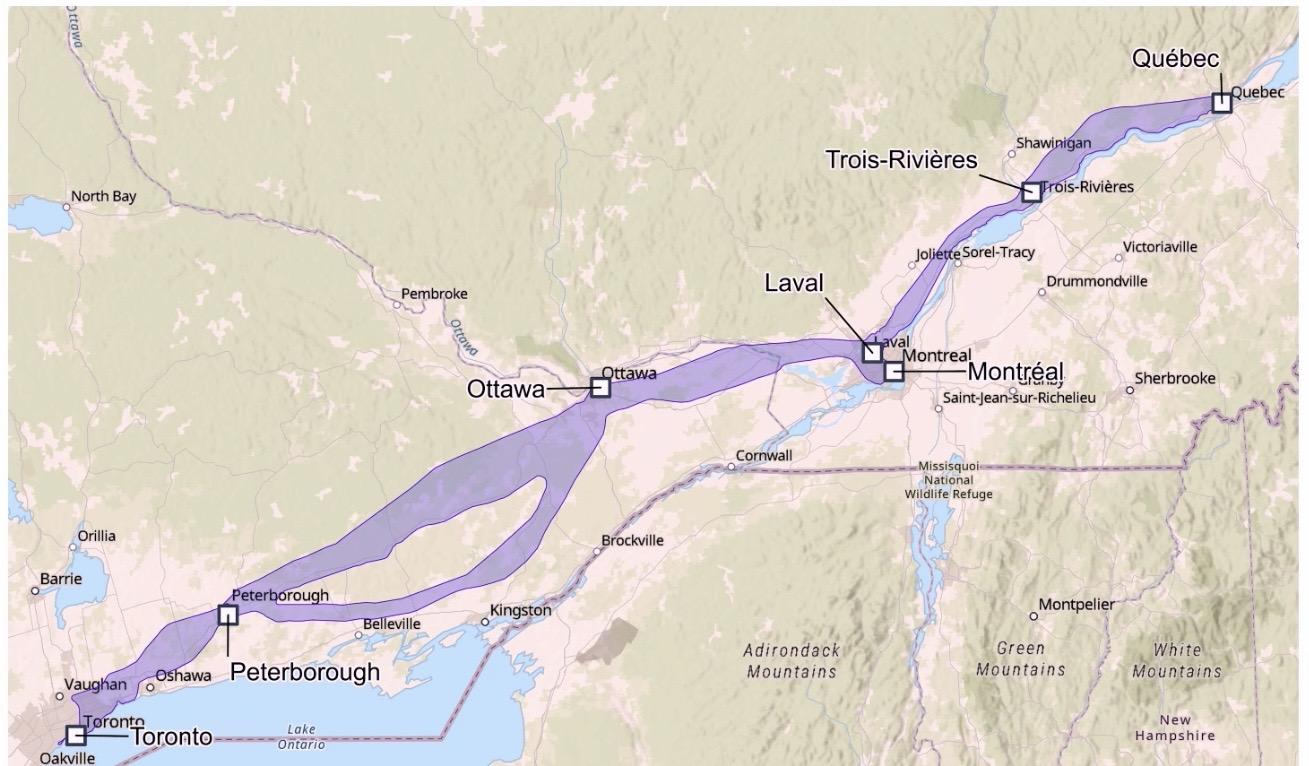
Alto plans to run from Toronto to Quebec City, with two route options through eastern Ontario
The Project
In February 2025, then-PM Justin Trudeau announced the Toronto-Quebec City High Speed Rail Project, and established a federal Crown corporation under the name of Alto to own and oversee the project’s “vision and planning.”
Alto is planning to construct ~1000km of electrified track dedicated to passenger trains operating at up to 300 km/hr. At a projected cost of 90 billion dollars, Alto would be the most expensive infrastructure project in Canadian history.
The project will require a 60 m wide tract of land all the way along its route. For reference, this is 2/3 of what is allocated to Highway 401 at its widest point in Southern Ontario.
Stations are only planned for Toronto, Peterborough, Ottawa, Montreal, Laval, Trois Rivières, and Quebec City.
The initial phase of public consultations was completed in April 2026 and a “precise corridor” is expected to be announced in the Fall of 2026. Landowners in South Eastern Ontario have already been notified of exploratory visits to their properties and expropriations could begin next year.
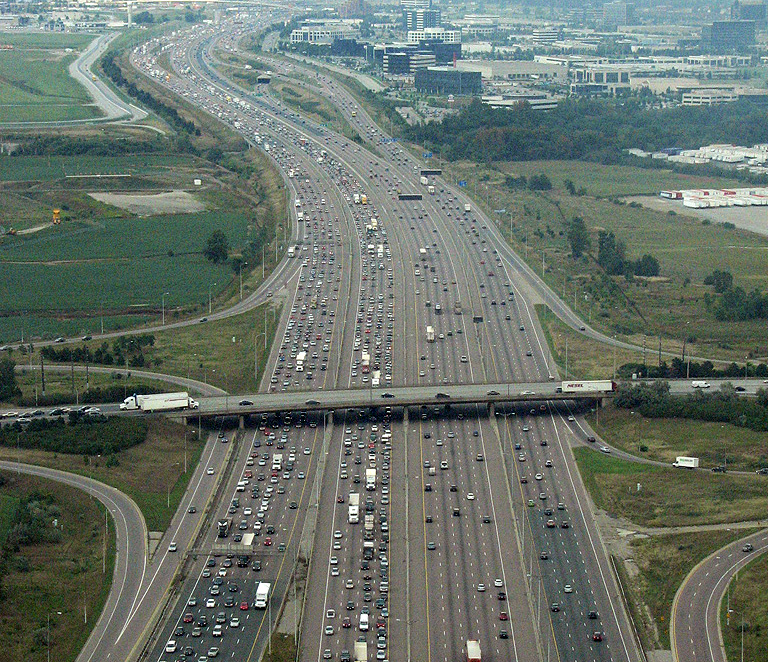
The fenced-off Alto corridor will be 2/3 the size of Highway 401 at its widest point in Toronto
The Cadence Consortium
Alto will be designed, built, operated and maintained by a private consortium calling itself Cadence.
Members include:
- CDPQ Infra: Lead developer of Cadence, owned by the Quebec’s public pension fund
- AtkinsRéalis (formerly SNC Lavalin): Large Canadian engineering and construction firm, high-profile scandals tied to the Liberal Party of Canada
- SNCF Voyageurs – French state-owned operator of the TGV (high speed rail network)
- Keolis: French public transit operator owned by SNCF and CDPQ
- SYSTRA: Engineering and consulting firm owned by French rail operators SNCF and RATP
- Air Canada: Canada’s largest airline with logistical and intermodal integration expertise
Timeline
- 2022: The Government of Canada announced The High Frequency Rail Project between Toronto and Quebec City, and established a dedicated Crown corporation under the leadership of Via Rail.
- February 2025: HFR project is converted into high speed rail project and Alto is established.
- March 2025: Cadence is selected to be Alto’s private partner. Mark Carney becomes Prime Minister, replacing Justin Trudeau.
- June 2025: Carney Government passes Bill C-5 “One Canadian Economy Act.Part of this bill empowers federal cabinet to designate “projects of national interest” and creates a “Major Projects Office,” intended to fast-track said projects.
- January-April 2026: First round of public consultations along the possible corridors – this is the first time most people in the affected regions became aware of the project, leading to the first large-scale public campaigns to oppose the project.
- March 2026: The “High-Speed Rail Network Act” is passed with the federal budget, exempting Alto from certain regulatory processes in order to speed up project approval, and granting Alto extraordinary powers in order to take control of privately-owned land along the corridor.
- 2029-2030: Targeted start of construction of track section between Ottawa and Montreal, billed as the project’s “test phase.”
- Early 2040s: Targeted completion of project.
We oppose this project for many reasons both personal and ideological.
Alto would bring immense ecological devastation to forests, wetlands, fields, rivers. It would ruin the soil and water along its route and downstream. All this destruction from now to 2040 when we’re already staring into an abyss of ecological catastrophe.
Alto would be a major attack on local wildlife through disruption of migratory paths, habitat destruction and disturbance.
Alto is a land grab. It represents a massive colonial expansion materially through land expropriation, and likely the expansion of police and surveillance infrastructure along its path. It also represents a new colonial expansion in the realm of hearts-and-minds and culture. High-speed rail has long been posited as an important “nation-building” and “modernizing” project for Canada, and trains have always been an important part of Canada’s expansionism both physically and on the level of the idea of Canada.
Alto would make any small city that gets a stop (currently Peterborough and Trois-Rivières) into commuter cities, accelerating gentrification in those places and making them even less habitable for poor and working people who live there already.
The Major Projects Office
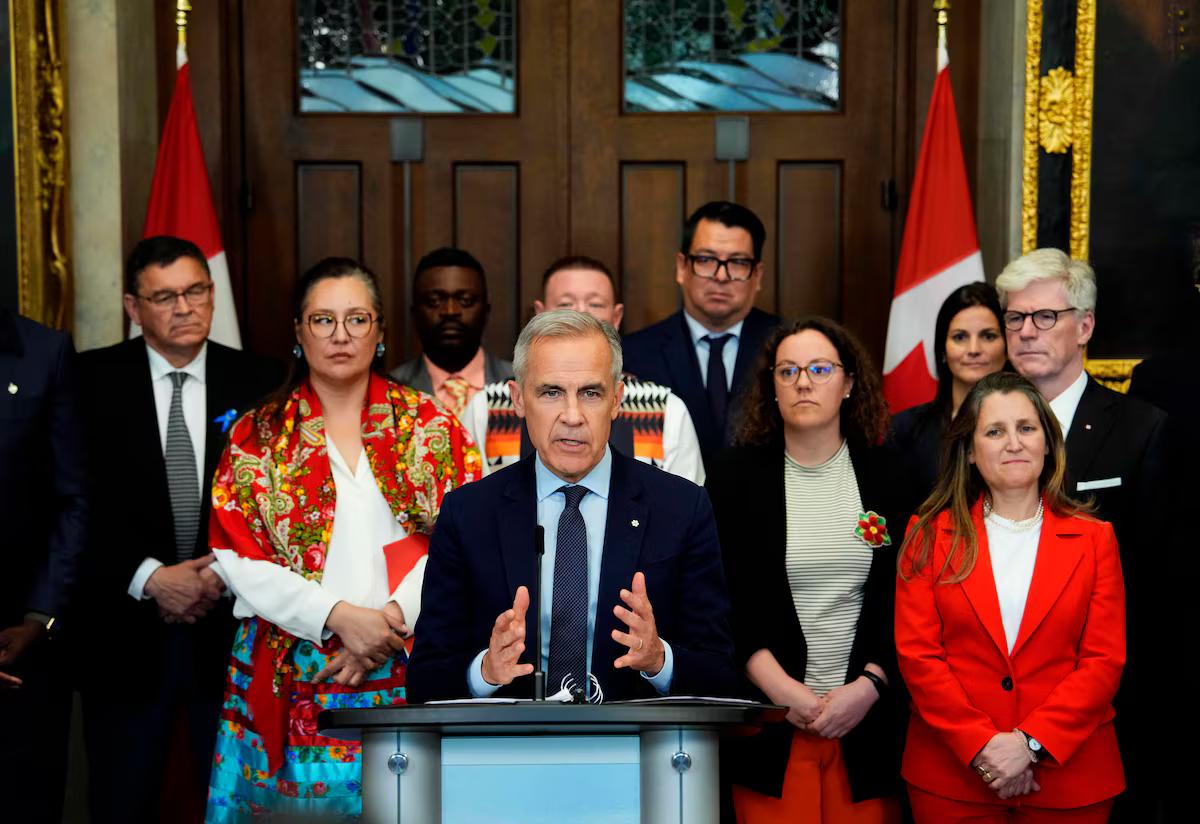
Liberal Carney government announcing Bill C-15
The MPO, headed by former Trans Mountain CEO Dawn Farrell, is a new body created by the Liberal Carney government to designate major infrastructure projects in the “national interest” and push them through quickly (2 year timeline).
Its purpose is to centralize approval authority in order to neutralize resistance to “nation-building” projects and minimize bureaucratic red tape. The MPO signals a decisive shift away from the Trudeau years of apologies, crying and endless sham consultations.
Alto is a very classically Liberal government megaproject: electrification/greenwashing, transit, developer-friendly. Others on the list include a mix of infrastructure required to support other extractivist projects (mining “critical minerals” and transporting oil and gas via pipelines) and green energy projects like large-scale carbon capture and wind farms.
The MPO is meant to make us feel like resisting these projects is impossible. But as we engage with the megaproject in our own backyard, we want to consider the opportunities to connect with and extend solidarity to those affected by the other megaprojects that the state is attempting to ram through.
Ecology
We are already experiencing ecological collapse. Extreme weather, destructive winds, torrential rain followed by drought, massive forest fires. Feedback loops devastate entwined ecologies and produce waves of further devastation. Water is also warming up, becoming too polluted with persistent chemicals, pharmaceuticals and microplastics. Soil is eroding and becoming depleted of nutrients necessary to sustain vegetation, which animals (including humans) depend on. Species are going extinct due to habitats destroyed by the damaging sprawl of colonial, capitalist society and infrastructure.
Within the Left and anarchism, there exists a kind of a green urbanist imaginary: walkable, dense neighbourhoods; green-energy-powered smart cities; accessible public transit; fruit trees lining the streets; cycling infrastructure; the perfect population size to benefit from supply/distribution efficiencies. The green urbanist imaginary is premised on green technocracy, whether grassroots, decentralized, or centralized.
Aside from entrenched culture-war camps, the biggest barrier to liberals, Leftists and anarchists opposing Alto is the misapprehension that it is an eco-friendly megaproject. Some imagine that building politicians and corporate commuters an electrified high-speed train will reduce carbon emissions. But that doesn’t account for the embodied carbon in the massive amounts of concrete required to build the track, the increase in new development spurred by the train, or the increased traffic due to detouring around the walled-off track. Not to mention that accounting for ecological devastation by counting carbon emissions is hopelessly inadequate and bleak.
Beyond that, another lie Alto’s proponents are trying to sell us is that the sparkly green electrified future can be powered by wind and solar. Electrification will require land-grabbing hydroelectric projects or potentially world-ending nuclear power, with its uranium mining and radioactive waste. Hydro and nuclear alike are extremely destructive to Indigenous lands, waterways and communities, in particular. There is nothing “clean” about sacrifice zones for the sake of a high speed train.
Canada
Canada itself is a megaproject. This megaproject is a settler colony founded on the genocide and dispossession of Indigenous Peoples and lands, primarily for the sake of resource extraction. This enclosure and extraction of so-called “natural resources” leaves a trail of social and ecological devastation in its wake. Canada also, like all states, expropriates agency from a mystified or estranged mass “electorate.”
Alto will grab a lot of actual land, a 60 m tract all the way along the Quebec City-Toronto corridor. This is the most densely settled area of Canada as well as home to a number of thriving and fighting Indigenous communities. It’s the historic “heart” of Canada, where business and government live. This corridor is already relatively easy to travel across by bus, train, car or plane. Making it even easier does not fulfill a real need – it’s about ideology.
Alto wants to sell us the idea that the space in between urban centres is empty, that we should feel like the physical world is as frictionless as the online world, that someone in Toronto could be neighbours with someone in Ottawa or Quebec City. That we are not rooted in specific places anymore, that living in one place is a thing of the past and we can actually “live” alongside whomever we “belong” with. The business class of Toronto, Montreal, and Quebec can all be one thing. So, we imagine, can the artists of all of those places, the architects of all of those places, the weirdos and radicals and youth of all of those places. We can think of a friend or a meeting or a project somewhere thousands of kilometers away tonight and be there with them tomorrow morning, home again by dinnertime. That the actual train may be too expensive for most to afford, and that the actual land in between Toronto and Quebec has people living on it already is irrelevant because it’s not about who will actually use the train – likely only the business class! – it’s about selling a story. This is the way with all megaprojects – their proposals sound ridiculous and impractical, so they need myths to prop them up. The actual purpose of the Alto project is the profits that will be generated by its construction.
There is also the matter of myths the state tells about itself. In Canada this has always been a challenge because its claimed land mass is so large. The idea of railroads has always been a major way that Canada sells itself as a coherent, reasonable state. John A. MacDonald’s Canada Pacific Railroad manifested Canada in the minds of many from sea to sea, even when the vast majority of that land was not settled by Europeans or controlled by any government. Alto sells us the idea that Canada is in fact a modern, rational, urban state “like those in Europe” when in reality it is basically still a resource colony, a playground for mining and forestry corporations propped up by the myth of an inclusive, liberal place for settlers to live.
Canada can be experienced as complete or total, but it’s not. Its attempts at totality are always unfulfilled. It’s a project that exists in tension with the resistance it faces. For example, the survival and ongoing resistance of Indigenous Peoples in the context of ongoing genocide. A project as ridiculous as Alto may or may not get built, and the moves people (including anarchists) make to oppose it will be an important determining factor in that.
Commuter Towns and Gentrification
Transportation infrastructure has contributed to rapid gentrification and increasing unaffordability in a lot of towns and cities.
Consider Hamilton, a city that was once relatively affordable, a working-class city, now a desirable location for commuters and totally unaffordable for most people. Light rail and real estate marketing have brought it into the orbit of Toronto to the extent that we now say GTHA (“Greater Toronto and Hamilton Area”) instead of GTA.
Politicians have been promising for years to connect Peterborough by rail to Toronto. Previously, this was conceived as a Go Train connection that could link commuter workers and travelers to the Lakeshore East line.
Peterborough is a fairly small city that has seen an explosion of homelessness and now dire poverty since 2020. During the pandemic, real estate drastically increased in value as folks with stable incomes and newly-virtualized work responsibilities from big-city Ontario turned their gaze to less densely populated areas with houses for sale a lot cheaper than in the big city. With investment properties, or properties intended to be shared with residential tenants, this put pressure on tenants as well. As real estate increased in value and price, the terms of these mortgages necessitated higher rents to make purchase viable. The new purchasers required vacant possession and the tenants had to go…
At the same time, working people on better-than-nothing wages, folks on social assistance, may have found themselves struggling to meet ends. The province allowed a break for paying rent and a moratorium on evictions. But then the moratorium ended and those months of back-rent became due. There was a proliferation of evictions for arrears, but also landlord’s own-use, subdivision/renovation, etc. Vacancy rates have now increased, meaning that apartments have been freed up, but they are not affordable and homelessness now seems like a permanent feature.
Politicians and capitalists love a rail connection for Peterborough for the very reasons that anarchists and activist types should hate it. It could make Peterborough a viable, green-space tourist destination for GTA folks to spend weekend money. It could also make Peterborough viable for people who are professionally employed in the GTA to commute to work.
The idea of Alto takes this idea and makes it even more threatening because it could make it viable for politicians and professionals who work in Toronto or Ottawa to live in Peterborough and commute. Alto is being compared to VIA Rail, which is not even affordable, and being conceived as a green alternative to jet travel.
Whether it causes local-regional suburban development sprawl, skyrocketing real-estate prices, or gentrification of the rental housing stock, the impact would be a trickle-down of displacement due to unaffordable rents and increasingly unaffordable cost of living generally for those who currently live here. We don’t know who else will be affected in this way yet, and we especially don’t understand if this will have a similar impact in Quebec, but we suspect that any city that got a stop on the train would rapidly become a tourist and commuter city, the next Guelph or Hamilton.
Anti-Alto Forces
In rural Eastern Ontario, where some of us live, opposition to Alto has become a virtual consensus during the last four months of public consultations, almost regardless of political affiliation. Heterogenous Facebook groups have formed in every township, environmental organizations have mobilized their members, demonstrations have occurred in the middle of nowhere, and municipal councils have passed resolutions opposing the project in its current form. In our limited experience living in this region, we have never seen this level of concern or mobilization around any other issue.
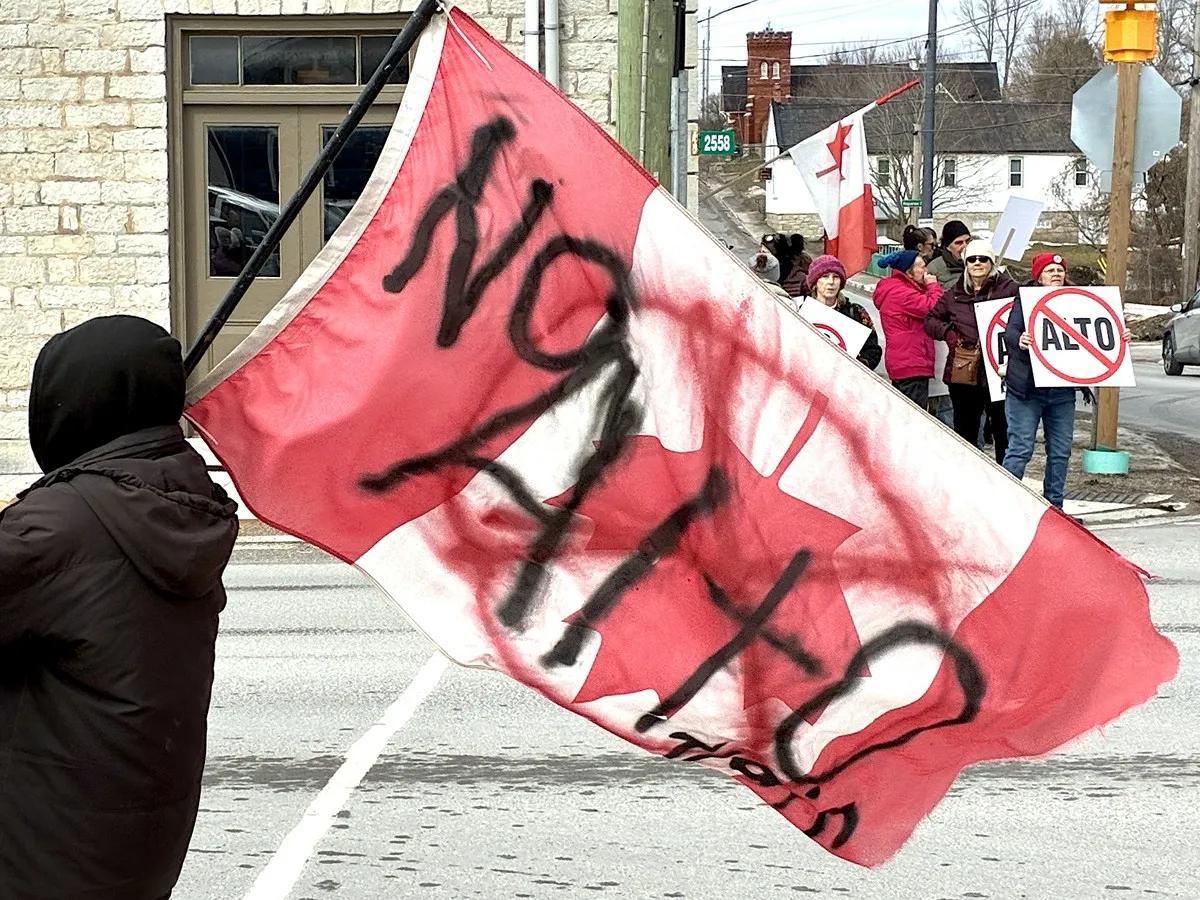
No Alto demonstration at a rural intersection in Camden East, Ontario
The primary grievance being aired is definitely centred around landowners (especially farmers) threatened with expropriation. Of course, this makes the movement vulnerable to capture by the Conservative Party and/or the far right.
There is also a significant bloc of people who are primarily motivated by environmental concerns about impacts to land, water and wildlife. While these concerns better align with an anarchist position against Alto, established environmental groups (even grassroots ones) are more vulnerable to pacification through the false promises of “consultation” and other “official channels.”
There are also various NIMBY groups pushing alternate routes, speeds or plans. For example the “Coalition For Better Rail” is advocating for a route along the 401 corridor, potentially with more stops to “serve” more cities. The City of Kingston is calling for a similar plan because they would like a stop in their municipality. Alto has said that such a route is not possible and is not being considered.
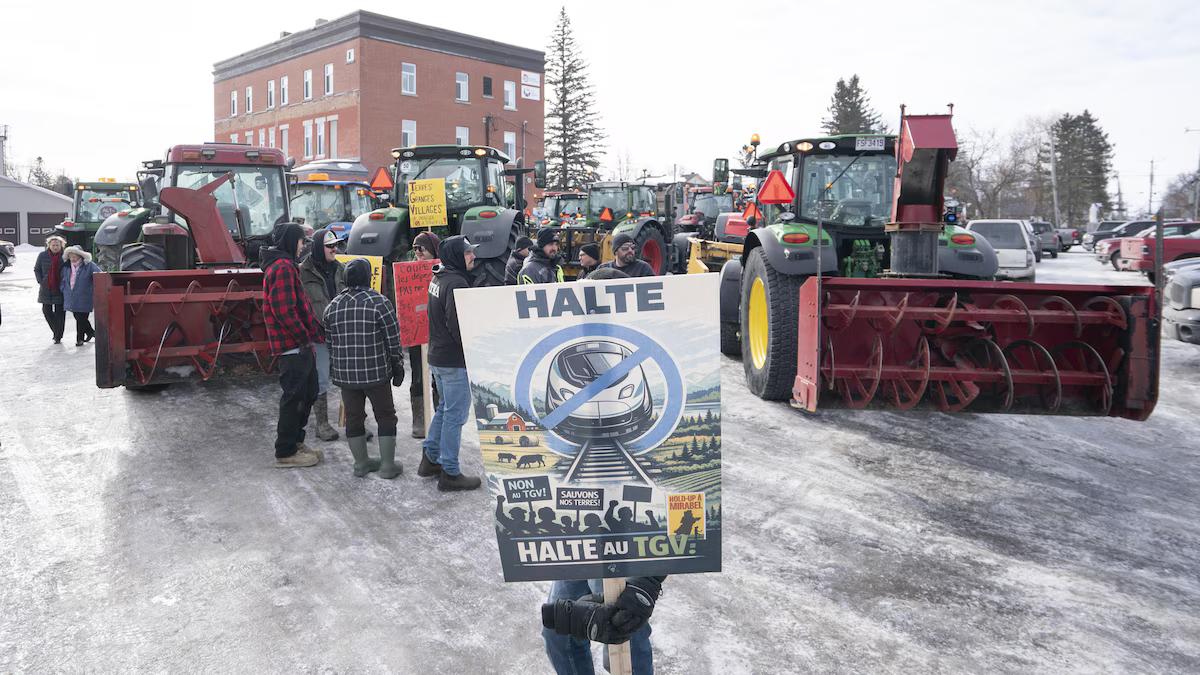
Tractor demonstration in Chute a Blondeau
The Rural-Urban Divide and the Far Right
It’s no accident that this project would cost 10s of thousands of dollars per Canadian citizen and yet benefit only a fraction of the population of 3-4 cities along the Quebec-Windsor corridor. The urban-rural divide and the regional “alienation” experienced by Canadians outside of that corridor are some of the oldest stories in Canadian politics. Since its inception, Canada has been a struggle by elites from Quebec, Montreal, Ottawa and Toronto to keep the rural people in between them and in the vast “rest of the country” looking and acting like willing participants in the story of Canada so that the resources they live alongside and on top of can continue to be extracted. That this is now a talking point of the political right and Alberta oil enthusiasts does not make it any less true. In fact, the Canadian nation-building/resource-extracting machine has long benefited from the idea that it is urban and its opponents are rural, conservative and backward.
Liberal elites from Ontario and Quebec” are both the strawman political opponent of Conservative movements past and present and the actual people behind the Alto project. Unfortunately for us, this makes opposition to the project appear to be the natural domain of Conservatives, and especially of what remains of the populist, libertarian and proto-fascist movements and communities that emerged during the first few years of the COVID-19 pandemic. These people are experiencing something that many anarchists and radicals know well, the emptiness felt in the years after a movement peak. They are itching for something to do, disillusioned by/bored of the idea that backing Pierre Poillievre’s Conservative Party is the right thing to do next, excited to use newly-gained organizing skills learned during the convoy movement, fired up about land rights and opposition to land expropriation in general, and pissed off already at the current government, which is championing the Alto project. Many of them also live in Eastern and Central Ontario, where the convoy movement was strong, and are rural landowners who stand to gain absolutely nothing, and in some cases actually lose their own land to Alto.
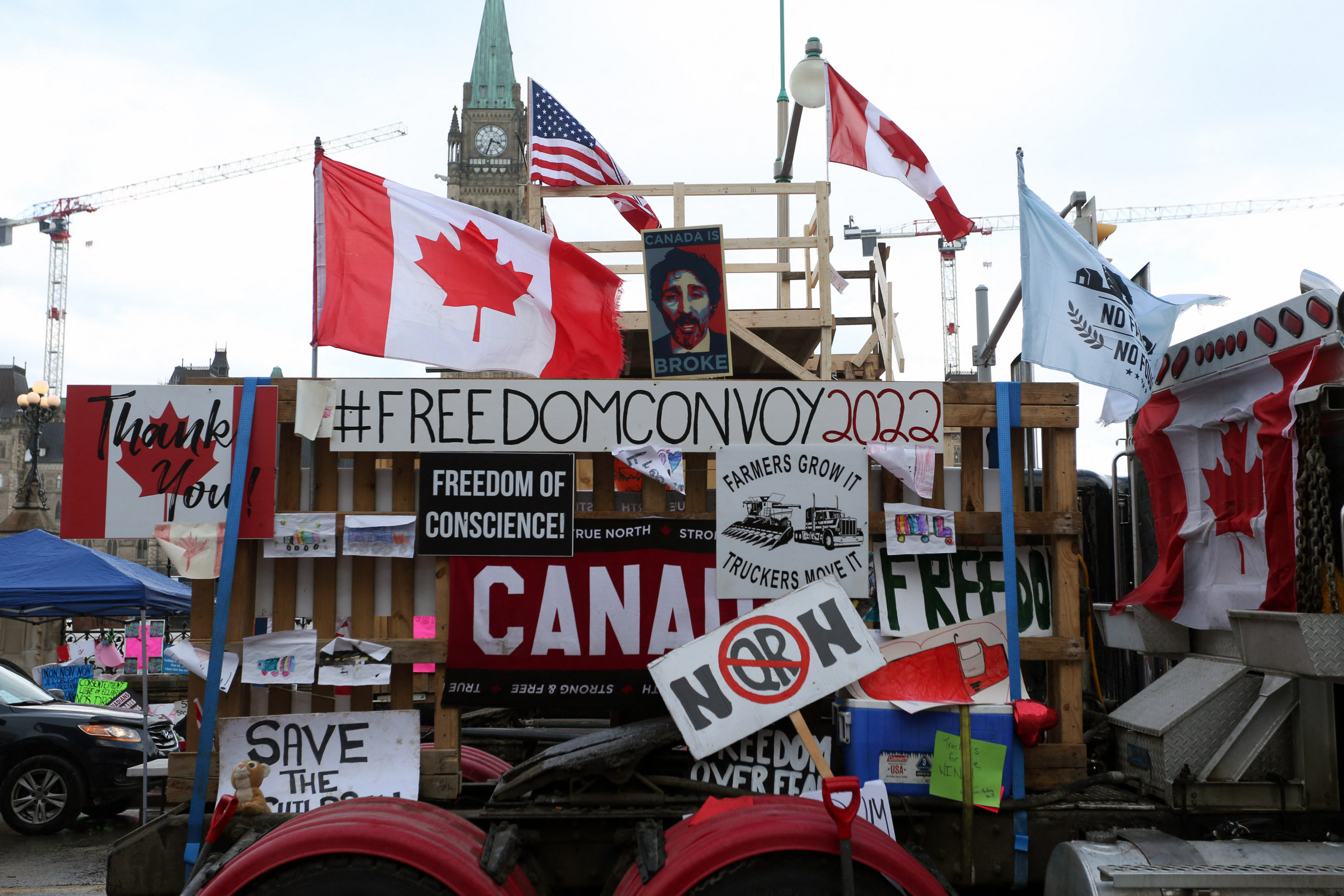
The so-called Freedom Convoy against COVID mandates peaked in Winter 2022
Of course there are liberals and leftists in rural Canada, even in the whitest communities. There are longtime land-owning families who don’t fit the stereotype of rural conservatism and there are more recent transplants from cities who now suddenly care about protecting rural land because they live there. There are many environmentalists who live there because they love nature or have come to love nature because they live there. But there are also a lot of conservatives, because a lot of them are reactionary landowners and a lot of them see that Liberals and the mainstream left in Canada only care about the interests of people in the largest cities. The push for high-speed rail and the constant talk about “electoral reform,” which would take voting power away from the rural right and put it in the hands of Canada’s urban (presumed liberal) majority are two of the promises that best demonstrate the Liberal Party’s total lack of interest in gaining back rural voters. They’ve literally been abandoned by the Liberal Party and often by urban progressive movements too, and now it looks like high-speed rail, which for a long time looked like a total pipe dream thrown around more to signal liberal values than to actually build any train tracks, might actually get built in their back yards. Conspiracy theories about 15-minute cities being fed to Conservatives and the vaccine-hesitant by Meta’s algorithms aren’t helping either.
Land ownership is a terrible basis for a political identity. The land does not and should not actually belong to white settlers and it’s not surprising that calls for governments to “back off my land” are left to the political right. But neither does small-scale land-ownership by farmers and other rural residents of this type make someone “the enemy.” Their identities are neither the problem nor the solution, and their desire to not have the land they live and farm on expropriated for a train to rush business travellers from Toronto to Montreal is valid. The political right has expanded its base in Canada in ways that 6 years ago seemed unimaginable to many of us, and as people who are also settlers and also live in these areas it does not make sense for us to abandon the entire context in which we live simply because the people there are more conservative than liberal. To do so will only help the Trumpist, populist and proto-fascist project that currently occupies many of our opposition movements. We would suggest that Liberals who have the capital and capacity to actually build megaprojects are greater enemies than misguided rural conservatives and the rank-and-file of the convoy movement anyway. Plus the train is a stupid idea and it must be possible to oppose it on our own terms, and perhaps connect with new friends and neighbours who can still be nudged away from the myth that they have to identify with conservative politics if they wish to continue living where they live.
Closing Thoughts, Open Questions
One of the main question we’re asking ourselves as anarchists is to what extent should we channel our energies into engaging and intervening with the existing opposition vs. developing a parallel struggle with other anarchists and radicals.
If we do engage with citizen or environmental groups, what can lead to more solidaristic and liberatory positions and projects? For example, linking Alto to other megaprojects being resisted by indigenous land defenders, framing the project as extractivism, etc.
What will happen to properties targeted for expropriation? If they are unsellable/removed from capitalist circulation or speculatively purchased by Alto and sit vacant for years, what opportunities might that present for us?
What have other anarchist struggles against HSR looked like around the world? How can we learn from those struggles while acknowledging very different contexts?
What did resistance look like to other very large government projects in the same regions, like Highway 401, Mirabel airport, the Trent-Severn Waterway, the Saint Lawrence Seaway…
How can we keep track of, if not join, existing opposition movements, both to see when they have potential and join in and to keep tabs on the fascists and populists who are definitely treating this as an opportunity?
How can we best counter progressive urbanists and techno-utopians who are supporting the train on grounds that may appear “of the left”?
The authors can be reached at friction@riseup.net
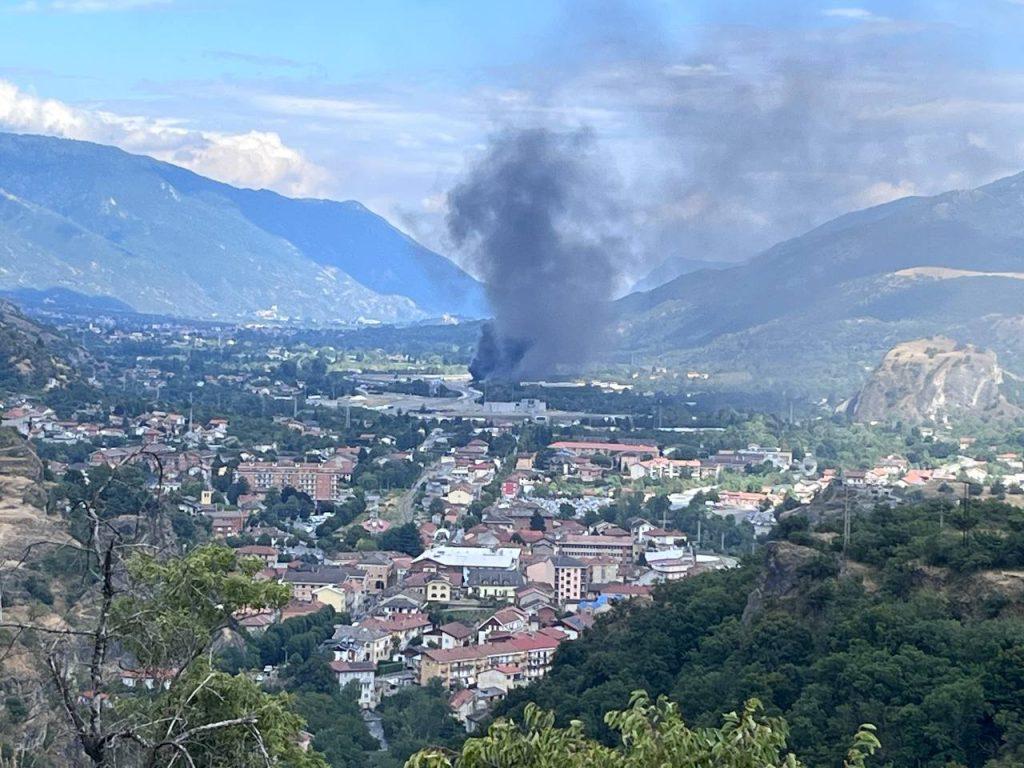
People have been fighting a high speed rail line in Italy’s Susa Valley for more than three decades.
“Land ownership is a terrible basis for a political identity. The land does not and should not actually belong to white settlers and it’s not surprising that calls for governments to ‘back off my land’ are left to the political right. But neither does small-scale land-ownership by farmers and other rural residents of this type make someone ‘the enemy.’ Their identities are neither the problem nor the solution, and their desire to not have the land they live and farm on expropriated for a train to rush business travellers from Toronto to Montreal is valid.”
What if there are no valid desires for colonizers as long as those desires align with the continued enforcement of european domination?
Destroy society => destroy societal projects, including alto AND the individual property rights threatened by the project. Defending either is defending hierarchy, capital, the state.
Attack, lay waste to it all. a better baseline than opposition to this project is opposition to the everyday. If anyone (anarchist or otherwise) is willing to pursue this…